AI makes it easy to start, but that’s not the hard part; tech builders forecast job shifts, product hiccups
September 22, 2026 | Taylor Wilmore

Julia Kanter, an expert in agentic AI and product experiences, shares a laugh with Ryan Shreeve, co-founder of TENEX.AI, during a Back2KC panel conversation at CPKC Stadium; photo by Taylor Wilmore, Startland News
Artificial Intelligence made prototypes faster and cheaper to build, said Julia Kanter, but that speed can create unrealistic expectations about how quickly a prototype can become something customers can actually use.
“It creates this false perception of like, ‘There’s going to be 15 billionaires tomorrow. We’re all going to value like $100 million ARR businesses,’” the expert in agentic AI and product experiences told a crowd gathered Friday for Back2KC.
 “Narrowing the scope is really, really important,” continued Kanter, who serves as vice president of product for Dallas-based software development firm LTK and previously led AI-related product management for Zillow.
The Kansas City tech insider was featured on a panel — “AI in the Heartland: What’s Real, What’s Next, and Why KC Matters” — alongside Usman Wajid, founder of Block and Mortar; Ryan Shreeve, co-founder of TENEX.AI; and moderator Gabriel Riekhof, an attorney at Husch Blackwell.
Speed of learning matters as much as speed of building, Kanter said. Companies need to figure out quickly what works, what does not and which problems are worth pursuing.
The number of AI products entering the market creates another challenge for companies, she emphasized: deciding what belongs at the center of their technology stack and what is worth testing on the edges.
Shreeve’s approach at TENEX.AI is to establish a core system and use smaller tools around it.
“Pick your big kind of central system of record, and then have some fun with the point solutions to surround it,” he said, noting that putting those AI systems to work inside real companies requires people, infrastructure and careful planning.
“It takes a whole army to implement this,” Shreeve said.
The AI conversation was part of a broader day of Back2KC activities aimed at showcasing innovation, culture and upward mobility in Kansas City — all as a means to lure former Heartland entrepreneurs and tech workers back to the region.
Back2KC panelists covered why AI pilots fail, what companies should consider when buying AI tools, how AI could reshape knowledge work and where Kansas City fits into it.
Shifting job descriptions
AI advancement’s impact on jobs is more likely to be focused on how responsibilities could change, rather than outright talent replacement, panelists said.
As AI agents take on more pieces of knowledge work, employees might spend more time reviewing what those systems produce and deciding what happens next, said Kanter.
“Many knowledge workers’ jobs increasingly will become reviewing the agents’ work and deciding go or no-go or making some edits,” she said.
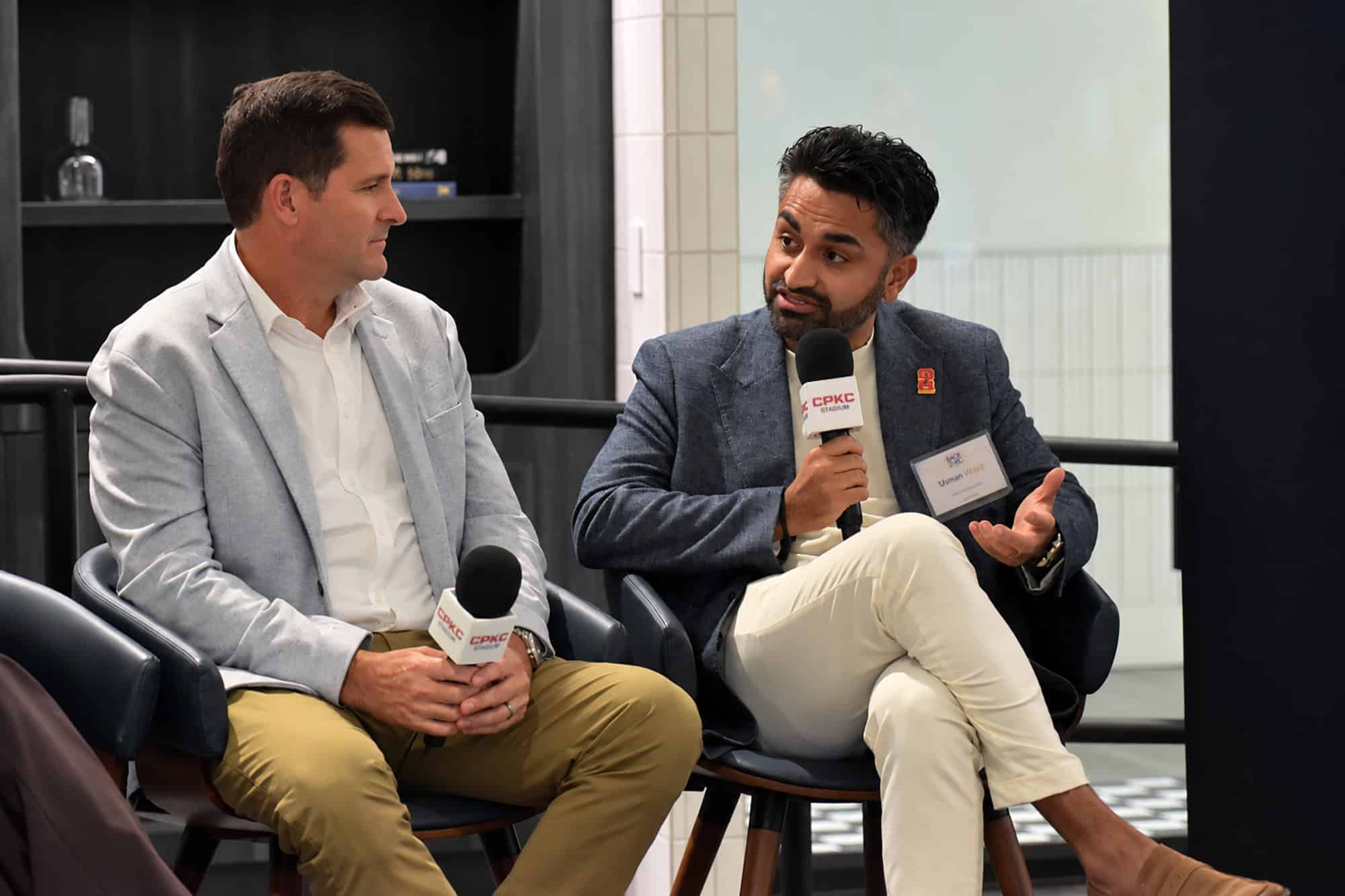
Usman Wajid, founder of Block and Mortar, right, speaks alongside Ryan Shreeve, co-founder of TENEX.AI, during a Back2KC panel conversation at CPKC Stadium; photo by Taylor Wilmore, Startland News
Wajid also sees AI as a way to preserve institutional knowledge as experienced employees retire.
“You’re going to be asking a lot of very young executives to make decisions without that knowledge that the executive before you made,” he said.
AI could help capture some of that expertise and make it available to the next generation of leaders, said Wajid.
The cybersecurity fight could accelerate
AI is also giving cybercriminals new tools. Shreeve pointed to phishing as an early example. Attackers can use publicly available information to create personalized messages that look legitimate, making them harder for employees to spot.
The bigger concern is what happens when those capabilities are deployed at scale.
“You’re going to need AI to combat the AI bad actors,” he said.
That could create demand for new cybersecurity tools and companies capable of responding to attacks with similar speed and volume.
Kansas City has a recruiting pitch
The conversation eventually came back to the local region itself. Wajid elaborated on how Kansas City’s universities are a key advantage, particularly as companies look for younger workers who have grown up with AI as part of their everyday lives.
Students entering the workforce now are accustomed to experimenting with new technology, he said, which could help local companies find employees who can incorporate AI into their work.
Kanter has also watched the region’s technology talent pool grow, especially over the past four years, she said
Kansas City’s cost of living could help that growth continue, she said, particularly for workers like herself who can work remotely but might otherwise be tied to more expensive technology markets.
Shreeve has seen that excitement over lower costs when engineers from San Jose visit Kansas City.
“They’re next asking what the house prices are here,” he said, adding that his company, TENEX.AI, is tapping local universities and offering relocation packages to workers interested in moving to Kansas City.
Affordability is part of the company’s recruiting strategy, Shreeve emphasized.
“If you know someone who wants to get back and is interested in a job, come and reach out to me,” he said. “We’re hiring, and we’d love to pay for them to come back here.”
Fund More Stories
This story was made possible by readers like you. Join them — make a one-time contribution or become a monthly member to sustain our work.