Royals stadium plans written in limestone; new design details put Populous placemaking on deck
October 16, 2026 | Tommy Felts
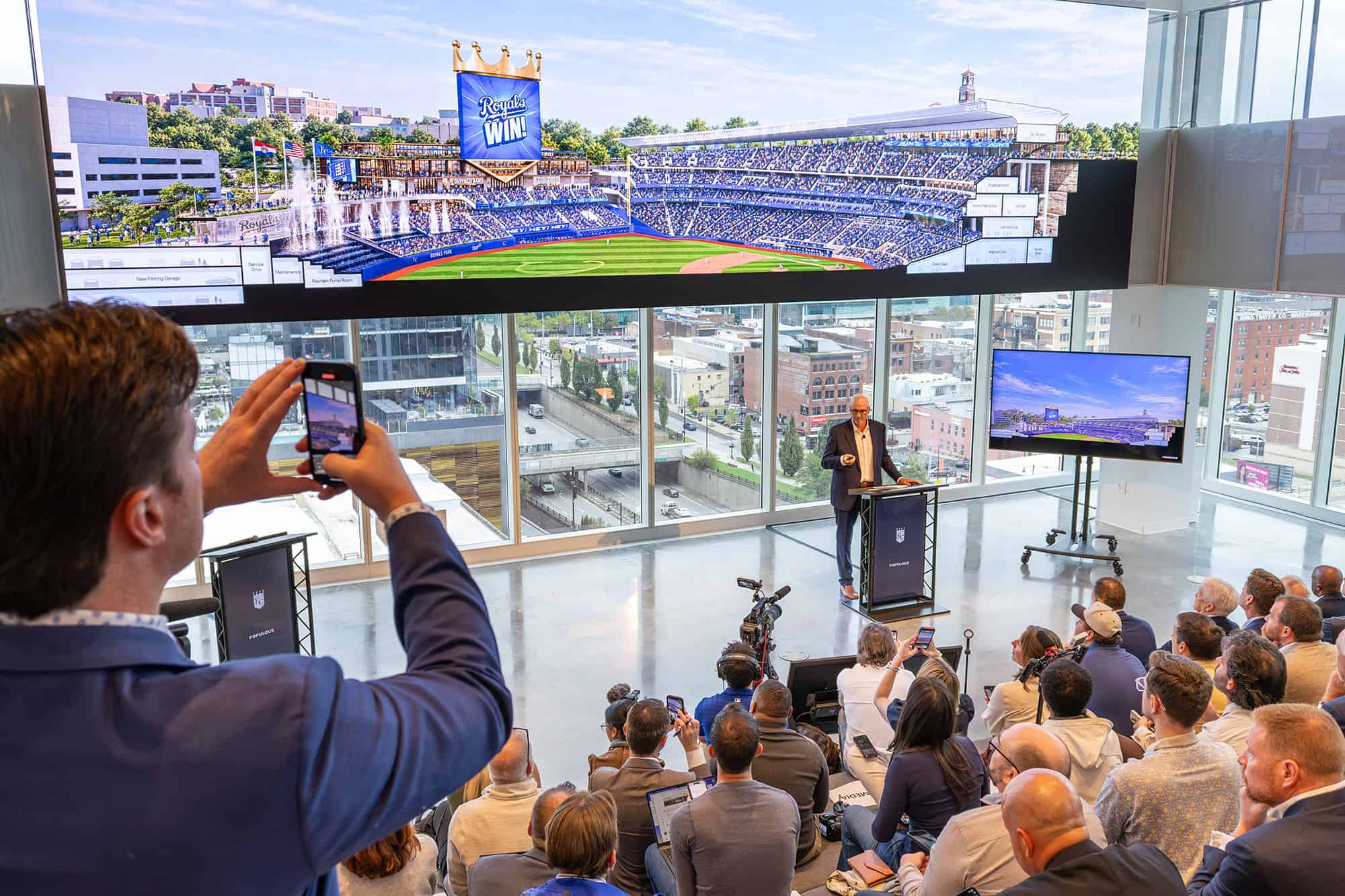
Earl Santee, senior principal and founder at Populous, reveals design features for the Royals' new ballpark at Crown Center, including stadium grounds built into the natural limestone of the area; photo by Haines Eason
A new Royals stadium built at Crown Center is expected to embed the baseball club into the foundational bedrock of the city itself for years to come — the physical expression of ballpark designer Populous’ strategy for placemaking within built and natural environments.
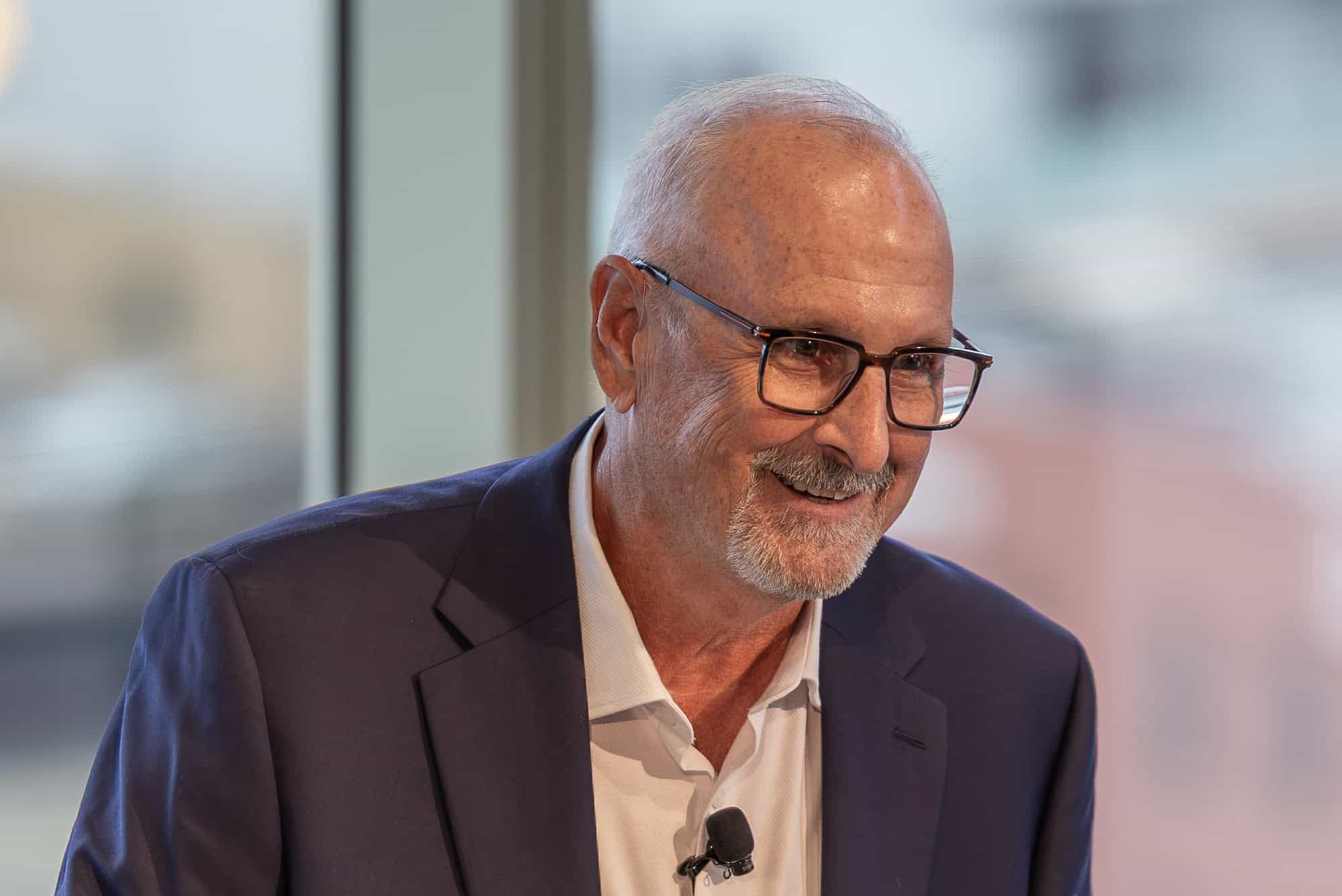
Earl Santee, senior principal and founder at Populous, speaks during a reveal event at Populous’ world headquarters in downtown Kansas City; photo by Haines Eason
“It’s about creating a more dynamic community baseball park,” said Earl Santee, senior principal and founder at Populous, the global design firm and Kansas City-based architect of record for the Royals’ downtown stadium project.
“We’ll design this ballpark one time, one place, for one community,” he continued, telling leaders and community members gathered for a design reveal Thursday at Populous’ world headquarters in Kansas City: “I promise you, you won’t be seeing us taking the design for this ballpark and plopping it anywhere else around the country. We’ll do this one time — for you all, forever.”
ICYMI: Royals drop six new renderings of Crown Center ballpark alongside ‘hometown design team’
“It’s authentic to Kansas City and we want it to be immersive, transparent, connected,” Santee explained of the project, which will see the Royals build a $3 billion ballpark district at Crown Center with the stadium literally set in stone atop what is now Hallmark Cards’ corporate offices — turning natural limestone that once vexed city planners into an integral piece of the sprawling development.
That vision begins at the ballpark’s “dramatic West Plaza” — an entrance that isn’t intended to be the stadium’s main gate, but where people will arrive if they’re coming to a game via the KC Streetcar, he said.
“To make this ballpark work, we have to dig a 90 foot hole, sculpt it out of limestone,” said Santee, noting builders will floss the existing stone infrastructure, removing dirt and debris built up around excavation from the original Hallmark campus built into the same limestone foundation. “The beauty of this is that it’s the simplicity of the architecture, but really the fact that it’s a warm and welcoming vision of what you can have when you come to a ballpark.”
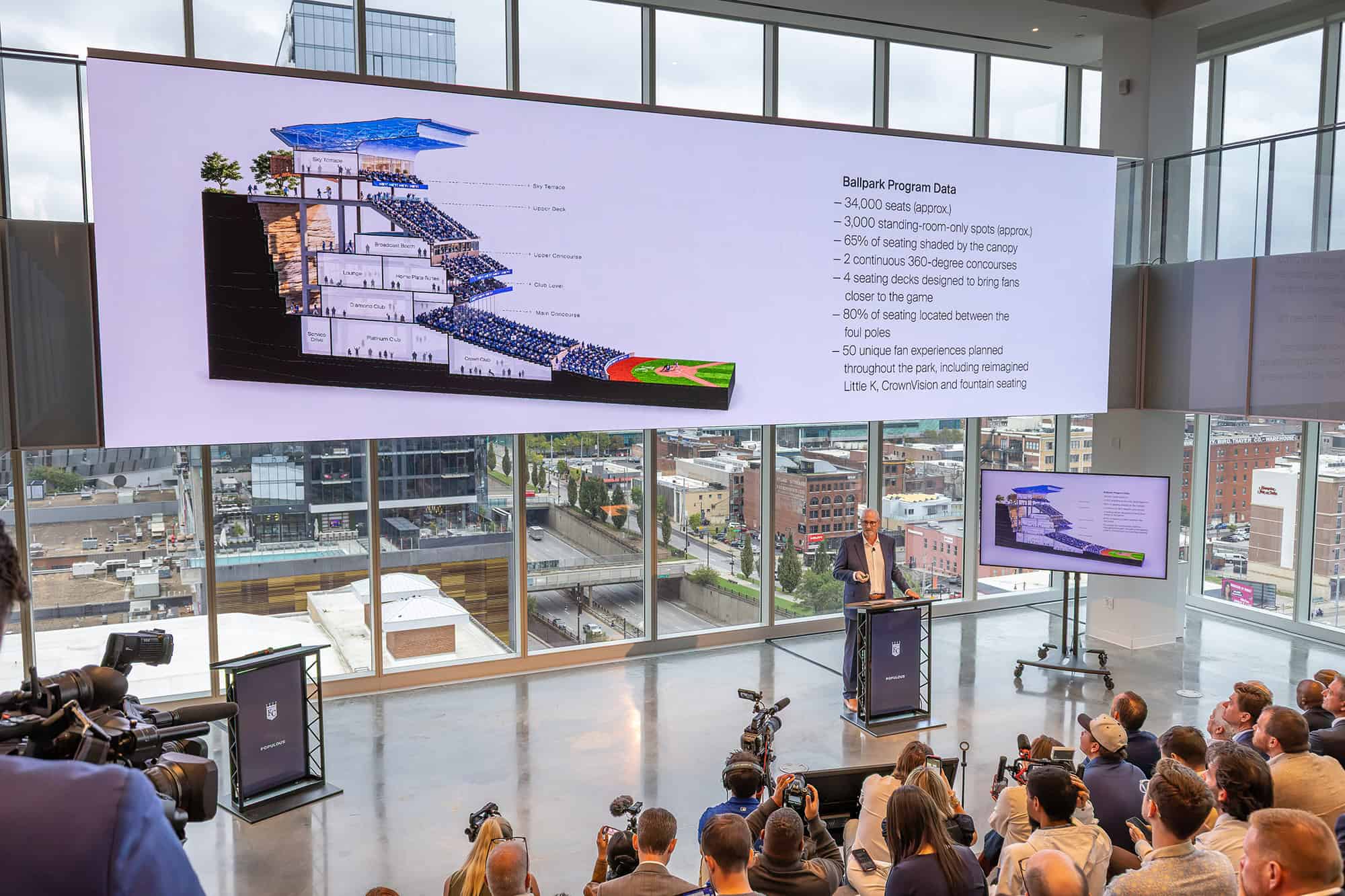
Earl Santee, senior principal and founder at Populous, details design features for the Royals’ new ballpark at Crown Center, including how the stadium incorporates the natural limestone beneath what is now Hallmark Cards corporate headquarters; photo by Haines Eason
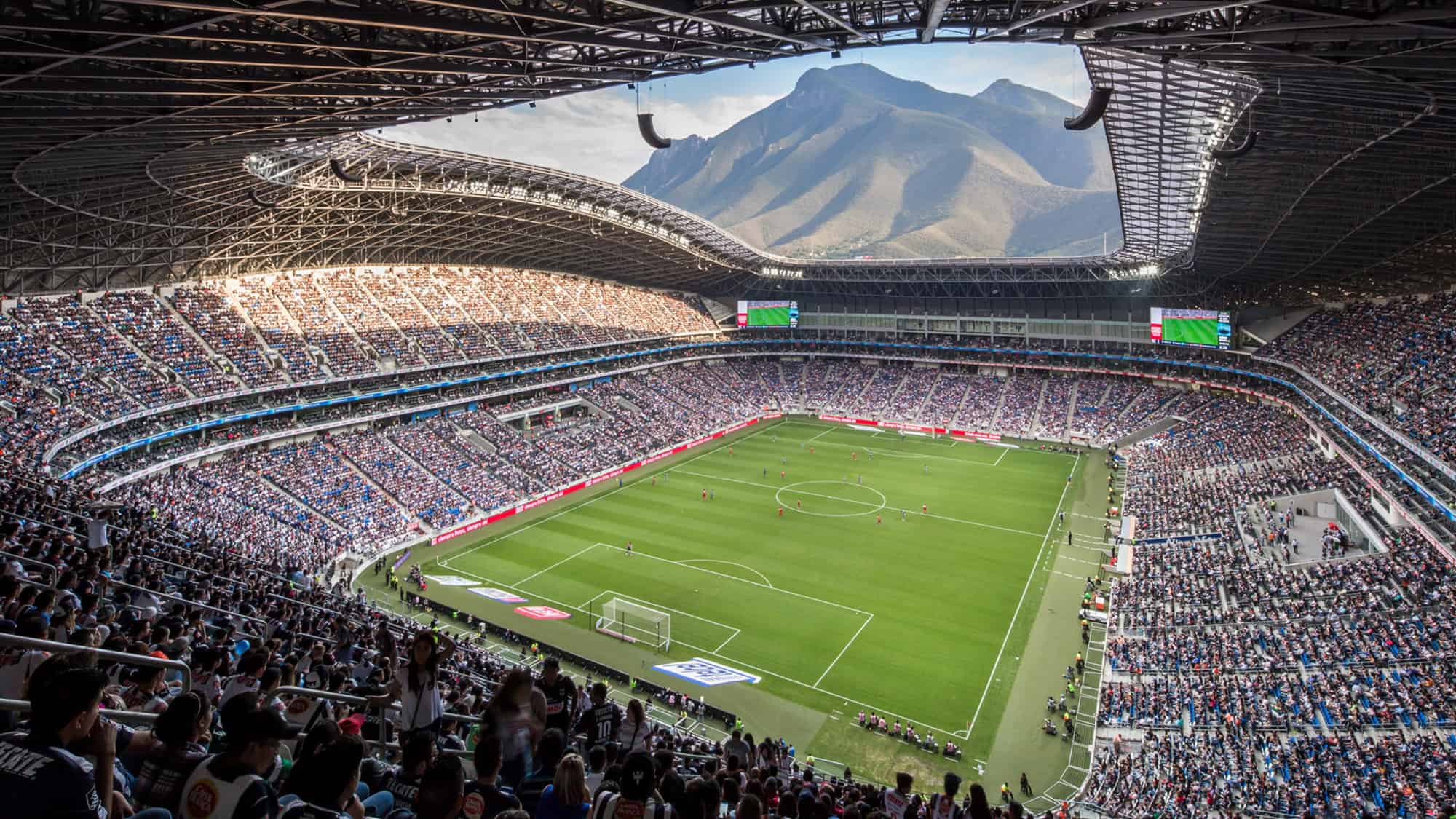
Estadio BBVA in Monterrey, Mexico — a 2026 FIFA World Cup stadium designed by Populous and now the home to CF Monterrey Rayados — showcases the firm’s strategy for placemaking. A cantilevered roof provides shade, as well as framing sweeping views of the nearby Cerro de la Silla Mountain; photo courtesy of Populous
Integrated deep within Populous’ strategy: it isn’t what the Royals are removing to make way for the stadium; it’s how the club will use what’s already there.
“We want to embrace the limestone,” Santee said. “The idea is that the limestone would be expressed as you’re experiencing the concourses. So you’ll feel like you’re always connected to the site.”
Showcasing the naturally occurring limestone also serves as a nod to some of Kansas City’s most iconic structures, he added, noting spaces throughout the stadium reflect those influences.
“We’ve taken our inspiration from things like the bridges around Kansas City, the landmark buildings in Kansas City — from Municipal Stadium, Municipal Auditorium, the performing arts center — many of the great buildings in Kansas City have limestone at the base and that’s the base of this building,” he said.
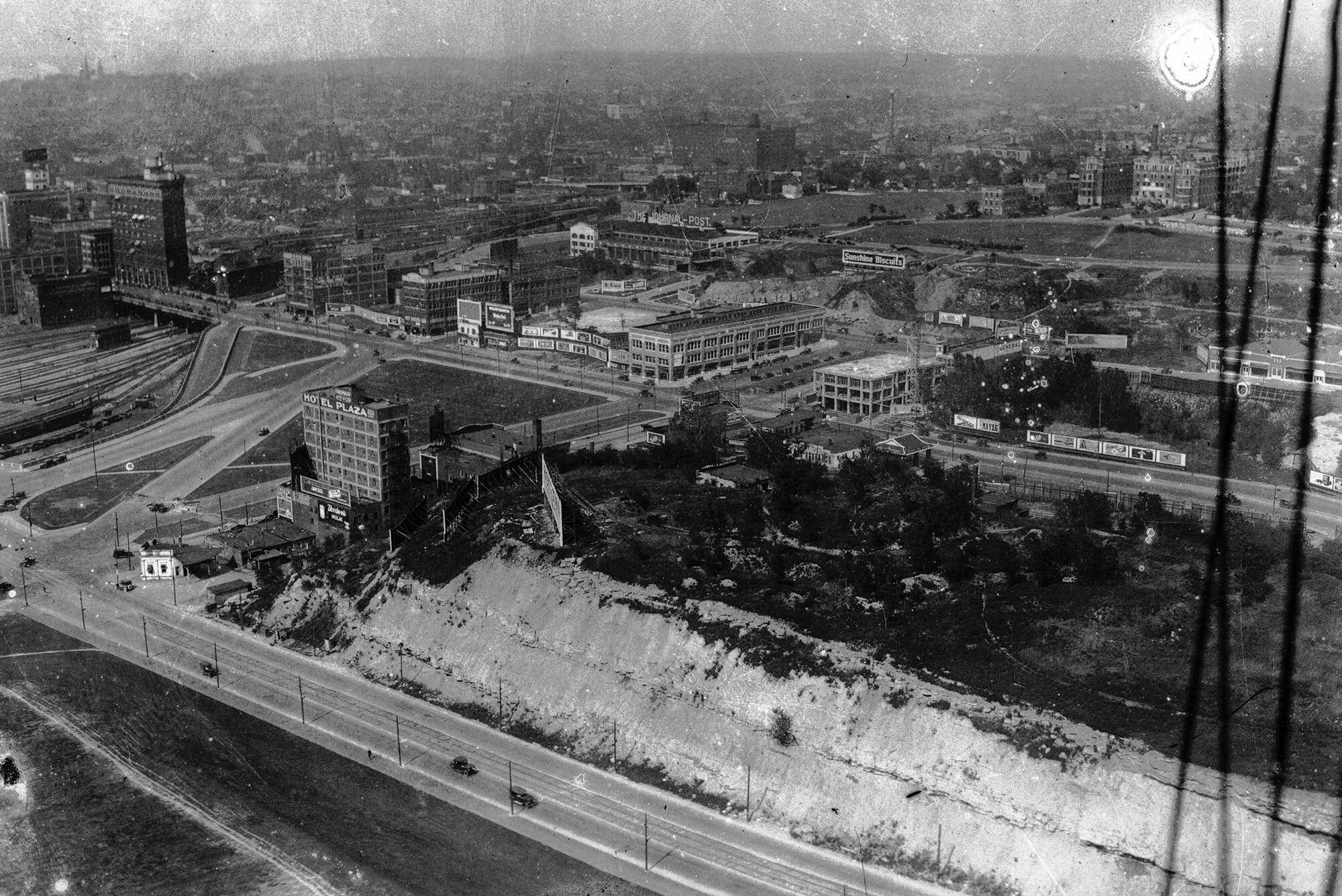
An aerial photo circa 1920 shows the area known as “Signboard Hill” at the northwest corner of what is now the Crown Center complex, specifically the site of the Westin Crown Center hotel; photo from the archives of the Kansas City Public Library, Missouri Valley Special Collections
‘Where others saw obstacles’
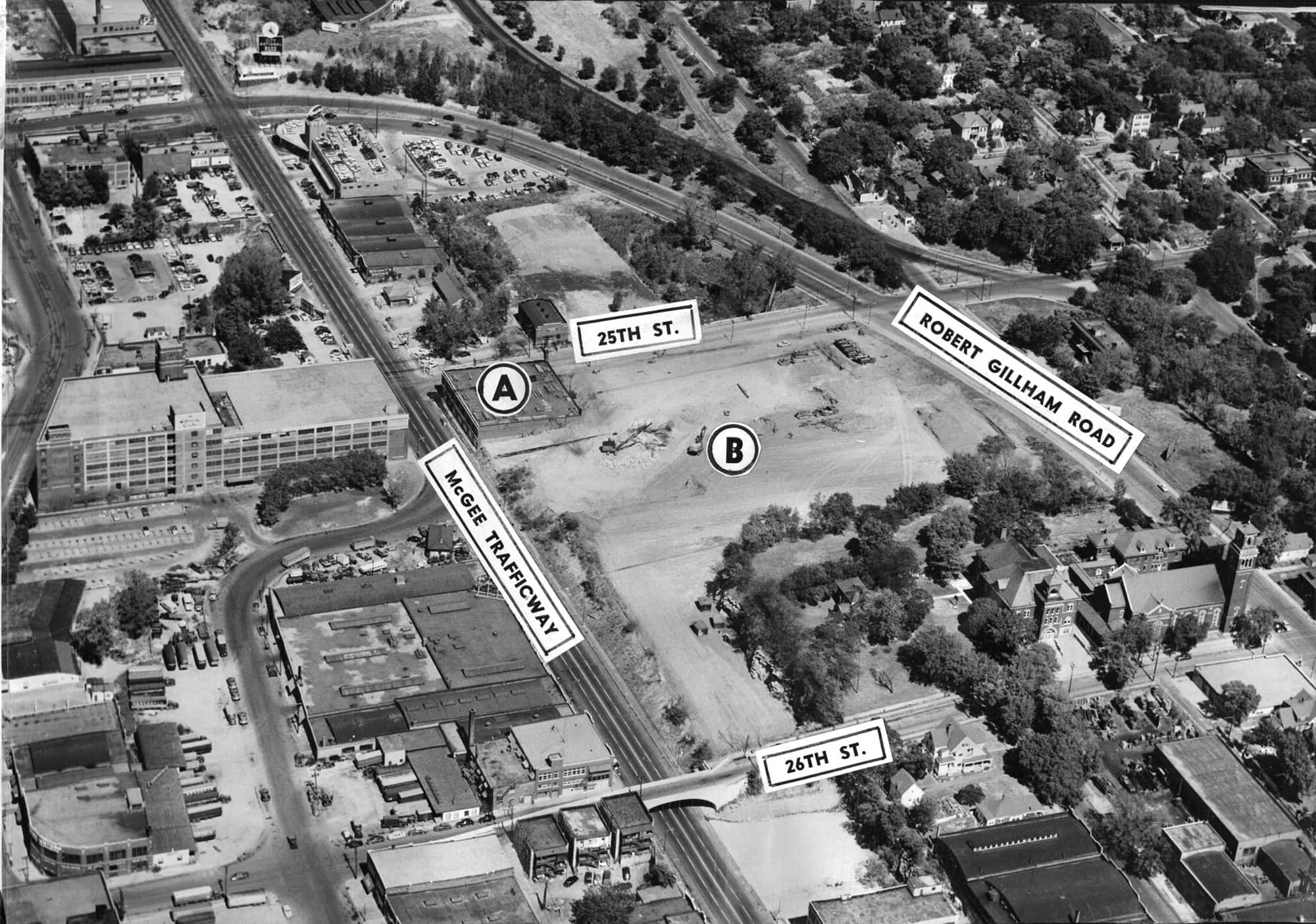
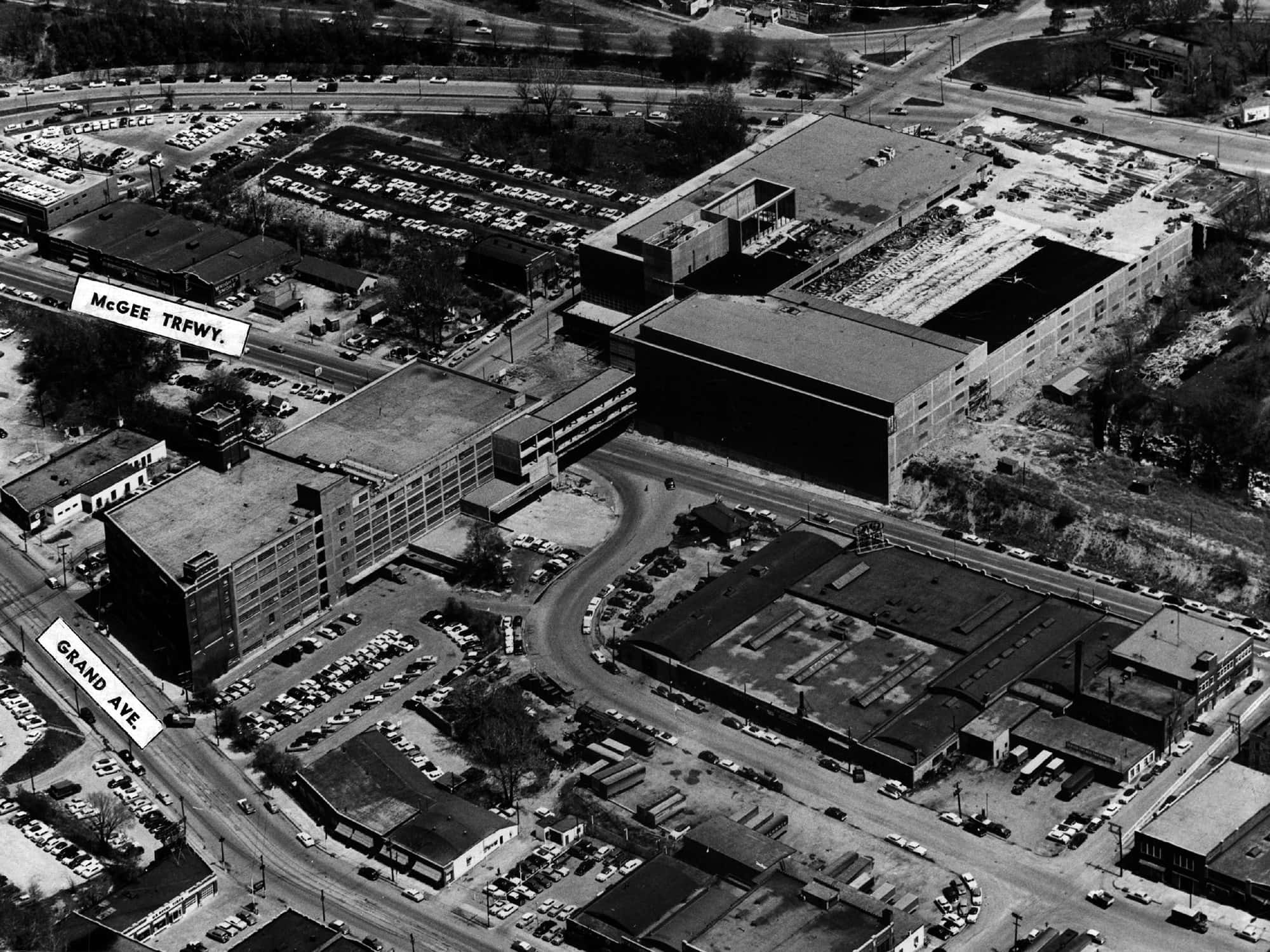
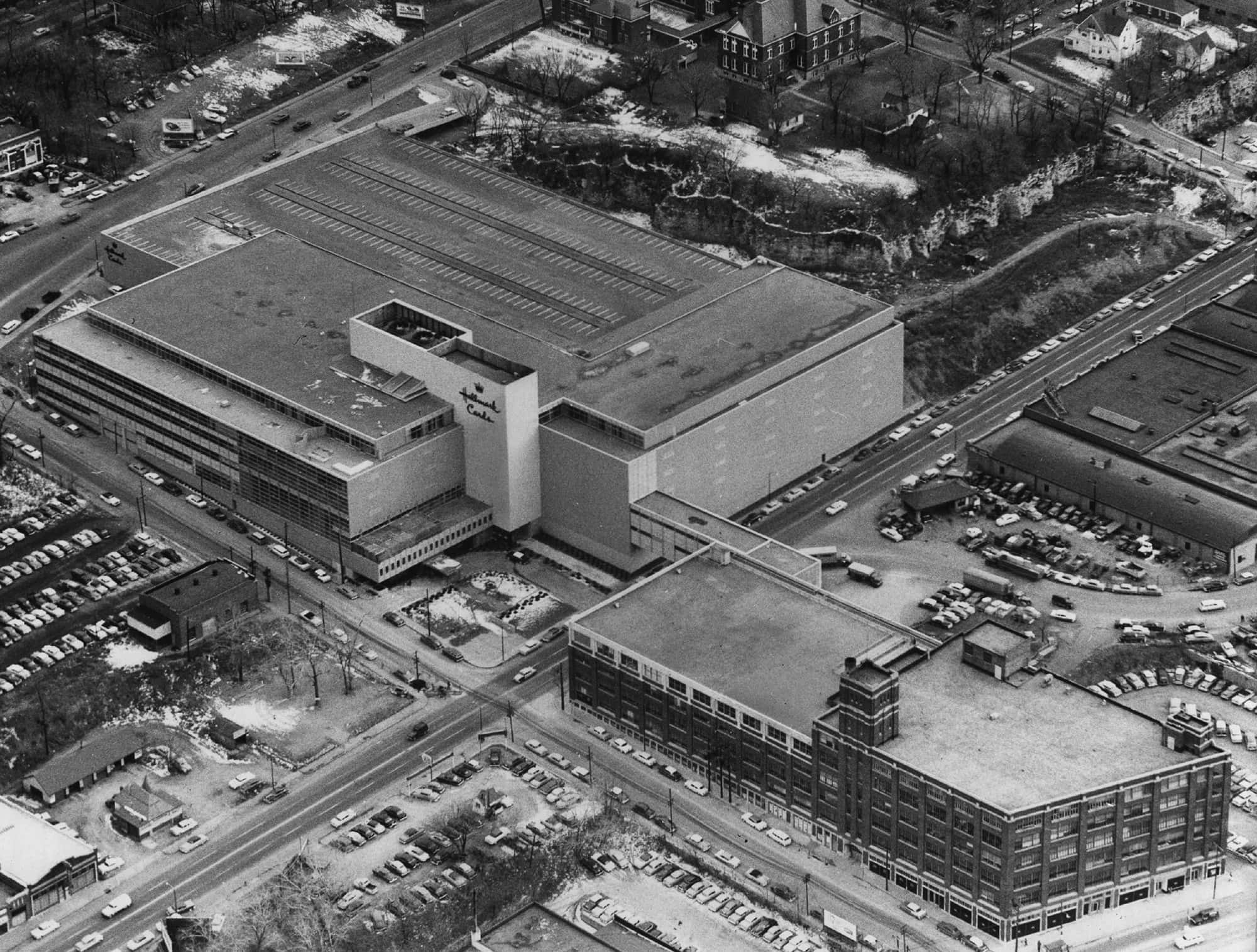
When Hallmark Cards opened its then-$8-million office and production plant at 25th and McGee streets in 1956 — the future home of the Royals’ Crown Center ballpark — the corporate complex sat not far from the city’s long-maligned “Signboard Hill.”
A craggy mess of limestone, weeds, and trees, the Signboard Hill area was eyed for development but its natural state made many options unfeasible. At its base, near Main Street and East Pershing Road — catty-corner to Union Station — billboards and signs were strewn across the landscape and an assortment of buildings popped up, but leaders struggled to capitalize on the otherwise ideal location because of hostile topography.
In an odd twist of history, Signboard Hill was even considered — in the years before Hallmark’s corporate construction — as the site for a future ballpark. A 1948 Kansas City Star report detailed a proposal for a 30,000-seat stadium with potential for an upper deck that could seat another 10,000 fans.
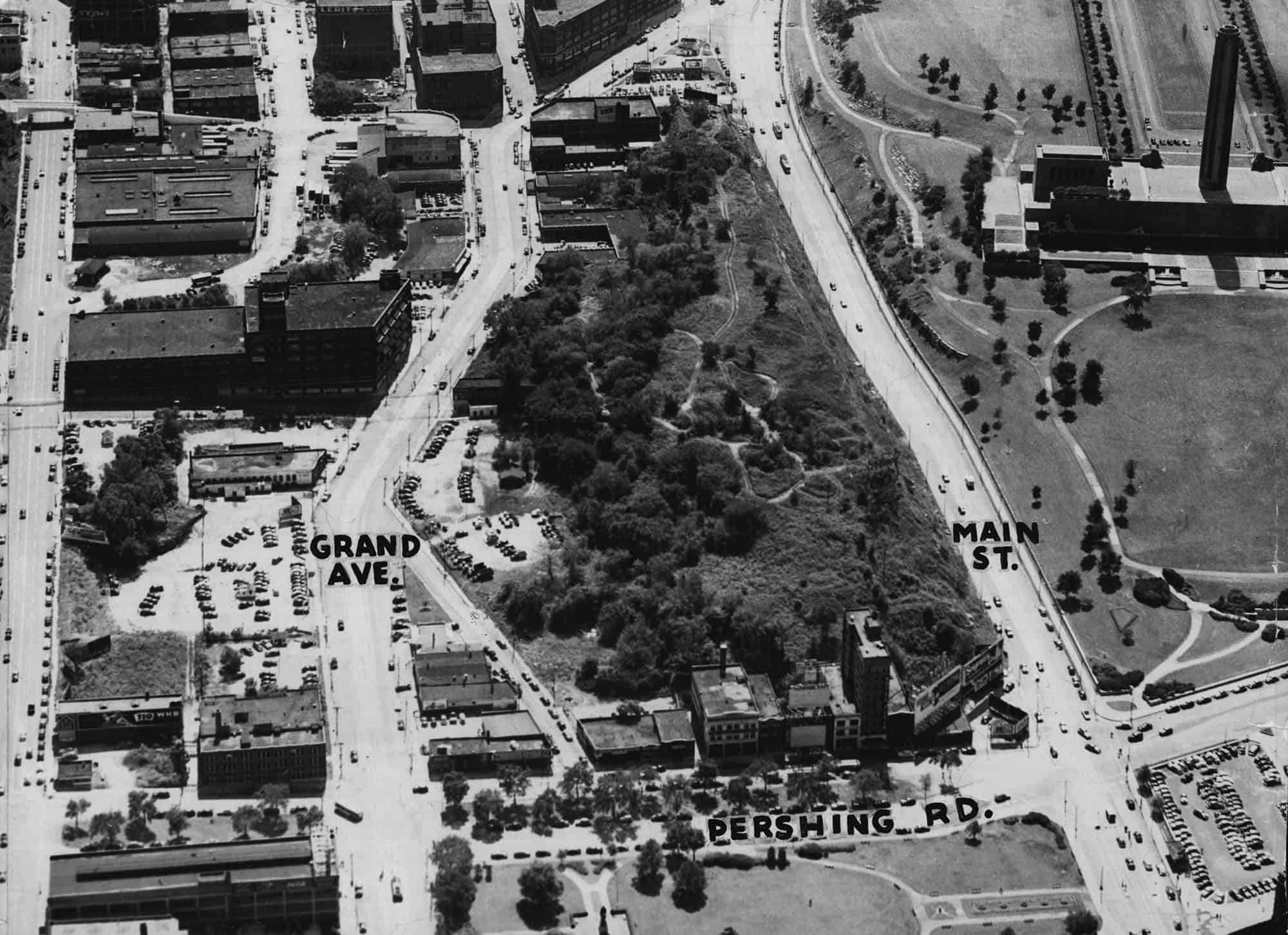
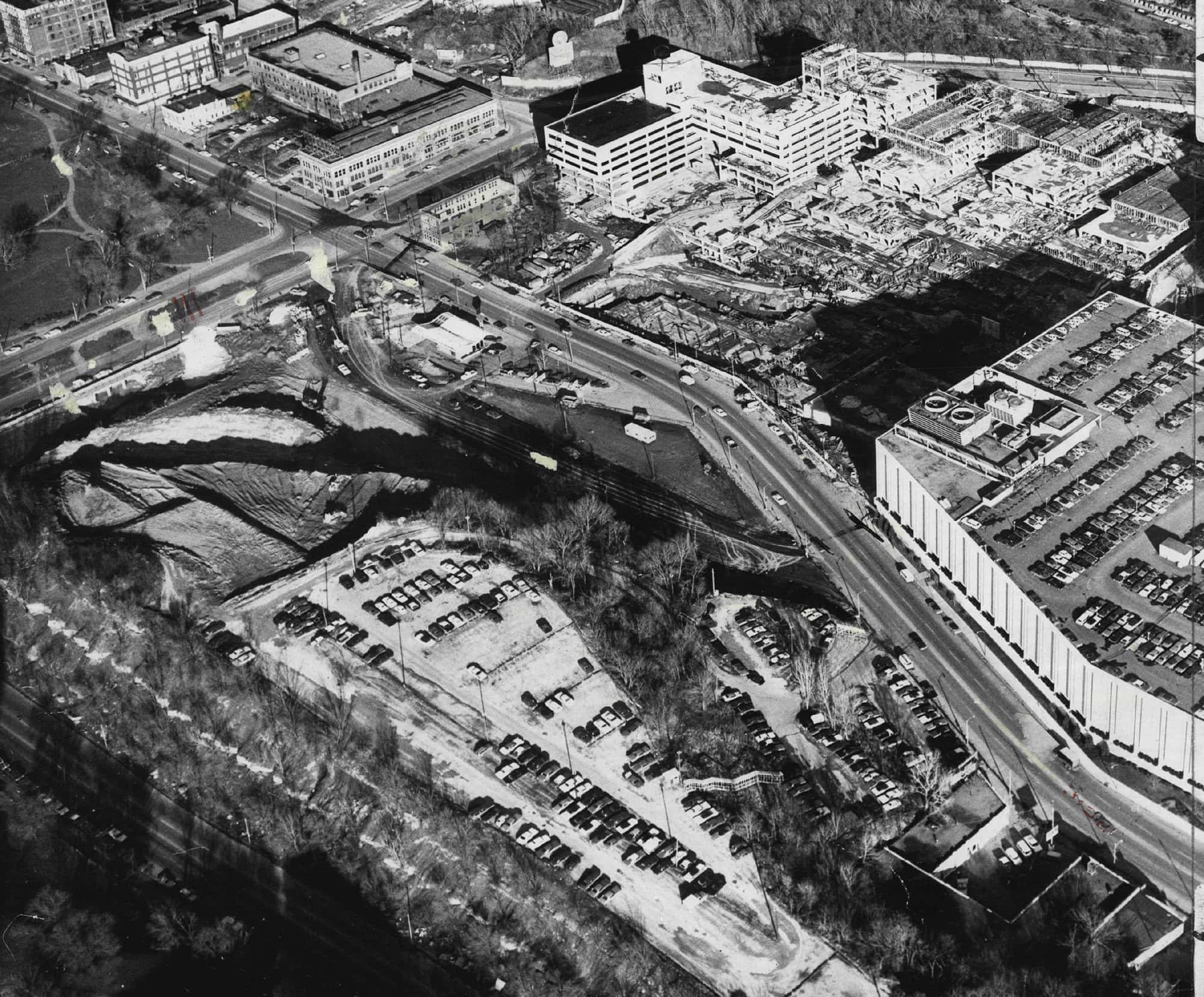
An aerial view of Signboard Hill, looking south, shows “the city’s unsightly landmark” where city leaders in 1948 considered clearing the ground to make room for a baseball stadium on a tract “about 1,976 feet long and 563 feet wide” that could fit 30,000 to 40,000 fans; photo from the archives of the Kansas City Star
The area’s widely uneven grading and winding roads cut through the limestone of the “city’s unsightly landmark” complicated the project. Leaders ultimately chose instead to renovate and expand the existing Municipal Stadium for Major League Baseball and welcomed the Kansas City Athletics to the space in 1955. (Signboard Hill later would be incorporated into Crown Center’s construction in the 1970s; integrated into what is now the Westin Kansas City hotel.)
“I grew up going to the Kansas City A’s games at Municipal Stadium with my parents, and it was such a great place for us to go,” said Santee, who noted his fandom eventually transitioned from the Athletics after the team left in 1967 for Oakland, to the Royals, which arrived courtesy of entrepreneur-turned-MLB owner and philanthropist Ewing Marion Kauffman in 1969.
The new Kansas City team debuted at Royals Stadium (now Kauffman Stadium) in 1973.
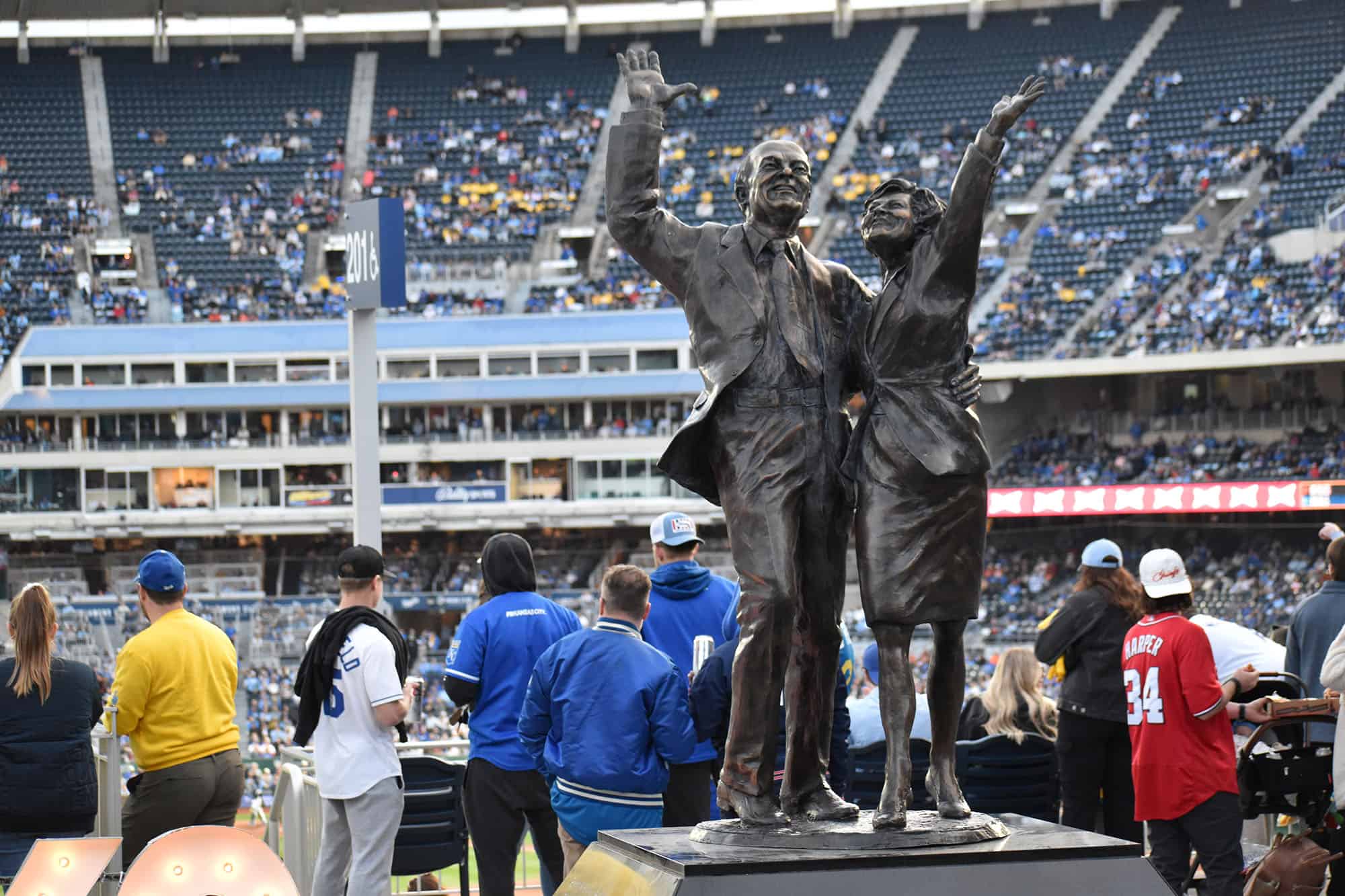
A statue depicting Ewing and Muriel Kauffman at Kauffman Stadium stands high over the ballfield as the Royals play a game in 2024; photo by Tommy Felts, Startland News
“This is where I learned to love baseball. I learned to love the art of baseball,” Santee said, drawing a correlation between the sport and the artistry behind the construction engineering at Populous that drives projects like the new Crown Center stadium.
The Royals would go on to host more than a half-century of play at Kauffman Stadium, earning two championships and building a Hall of Fame roster that includes such Kansas City greats as George Brett, Hal McRae, Bo Jackson, Cookie Rojas and Bret Saberhagen.
Before Kauffman’s passing in 1993, the team owner set in motion a plan to keep the Royals in Kansas City — hoping to avoid the fate of the Athletics, which abandoned the community citing low attendance and the team’s poor performance — by donating the Royals to the Greater Kansas City Community Foundation upon his death, with strict conditions tied to its future sale.
RELATED: 5 ways Ewing Kauffman changed baseball
The team eventually sold to former Walmart executive David Glass in 2000, then to current owner John Sherman in 2019. A former vice chairman of the Cleveland Indians (now Guardians) and longtime Kansas Citian, Sherman pledged to follow Glass’ lead — maintaining Kansas City as the home of Royals baseball — while quickly seeking to bring the team to a new stadium downtown.
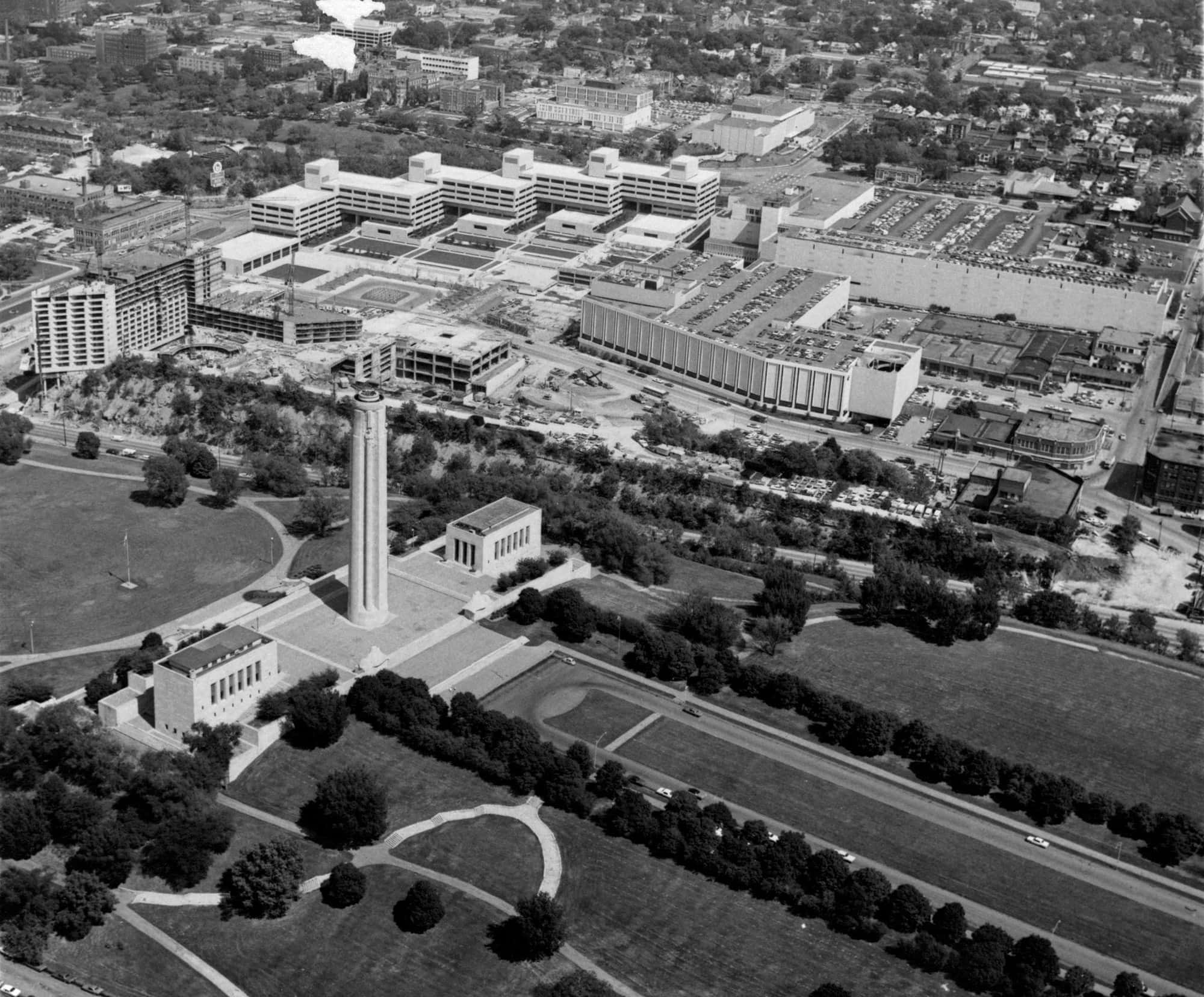
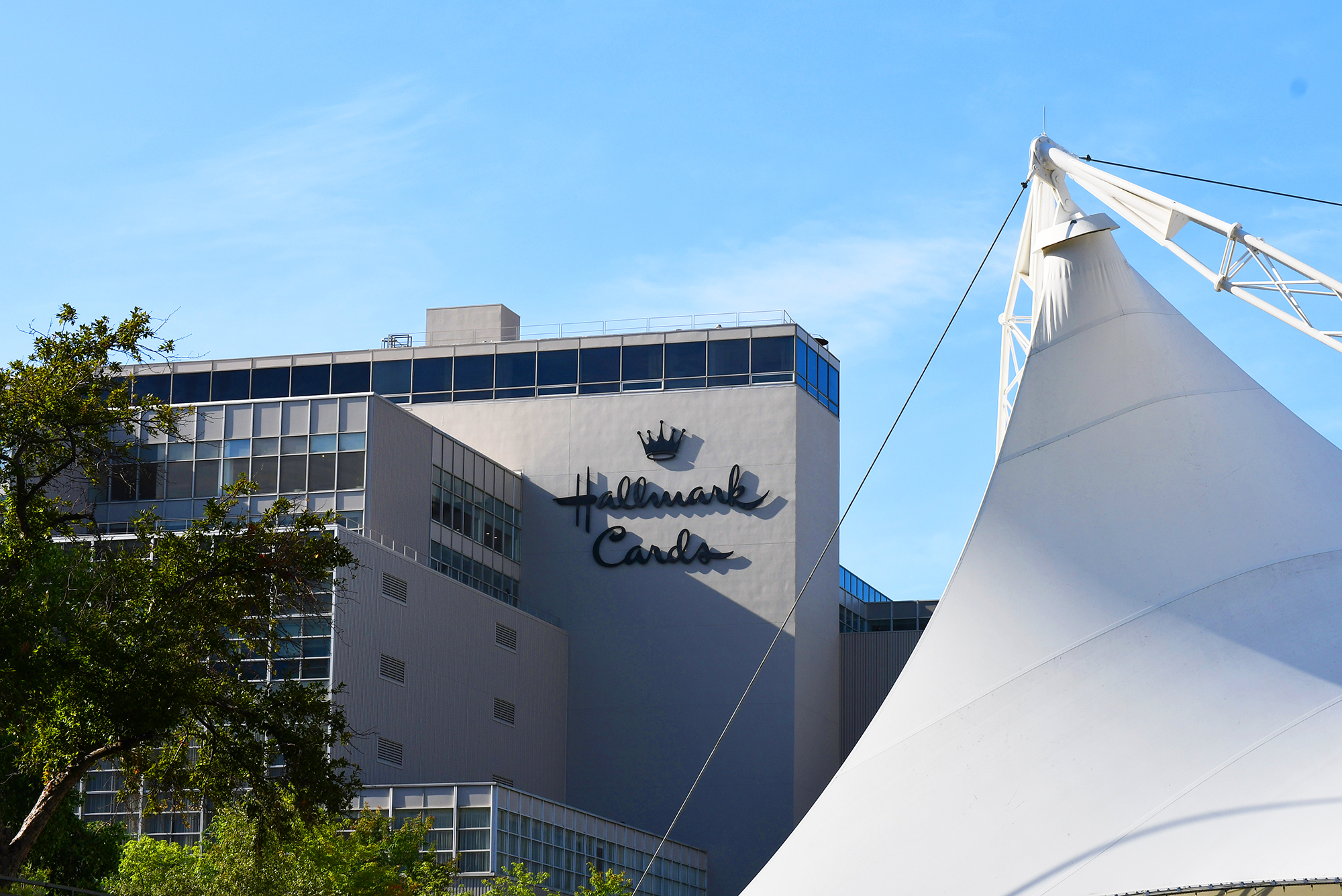
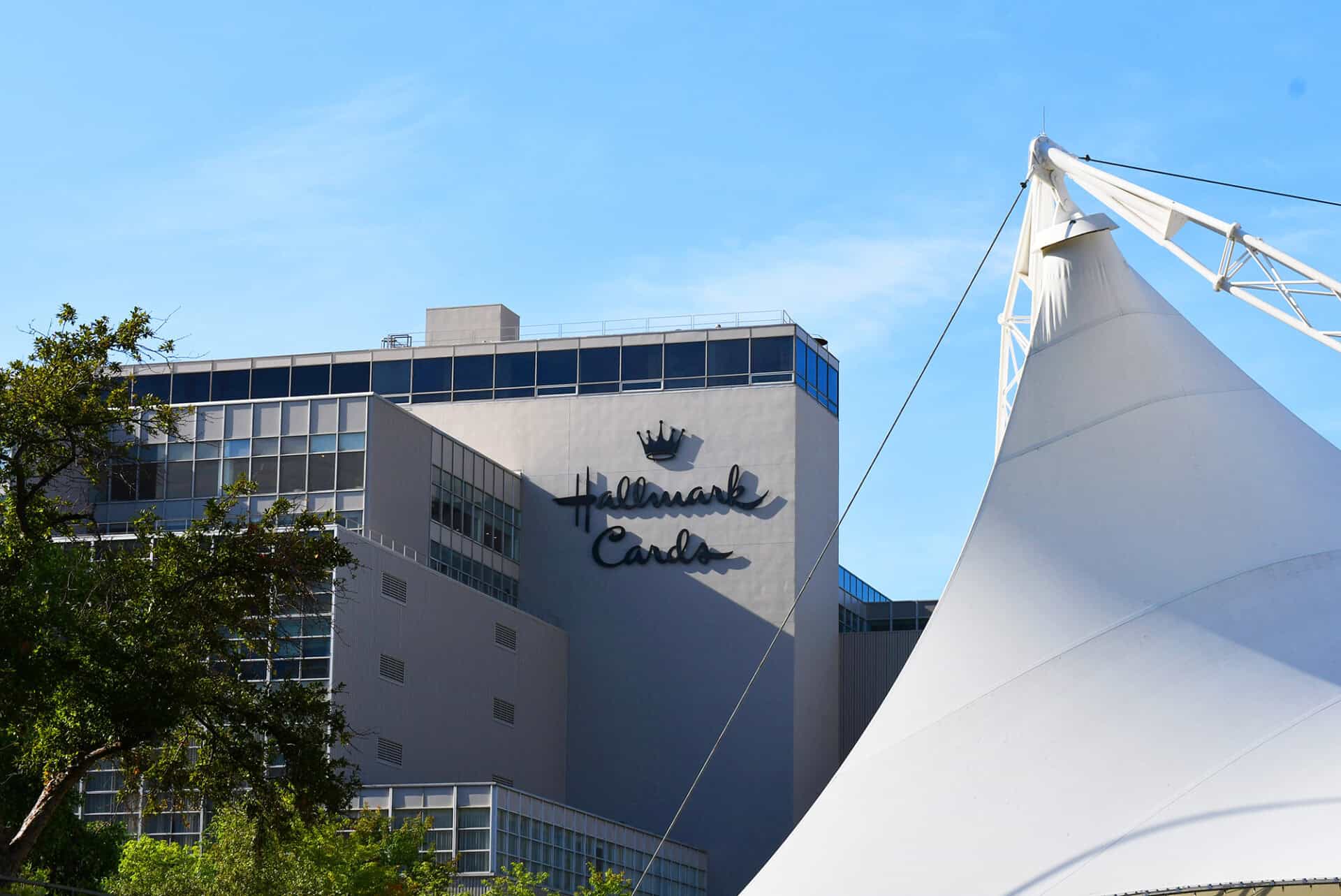
Hallmark Cards corporate headquarters sits at Crown Center, near the site of the future centerfield for the Kansas City Royals new ballpark, set to open in 2030; photo by Tommy Felts, Startland News
While the Hallmark Cards site wasn’t the first location Sherman eyed — the baseball club also considered locations in North Kansas City, the East Village, Crossroads Arts District and reportedly even Johnson County, Kansas — the team is now heavily leaning into the Crown Center area’s geography.
A location that once limited potential for a ballpark now encourages it thanks to nearby investments and design advancements.
“This will be the best neighborhood ballpark in the country, accessible to many more by foot, bike, bus, KC Streetcar, and thousands of parking spots within a short walk,” Sherman said Thursday in a statement.
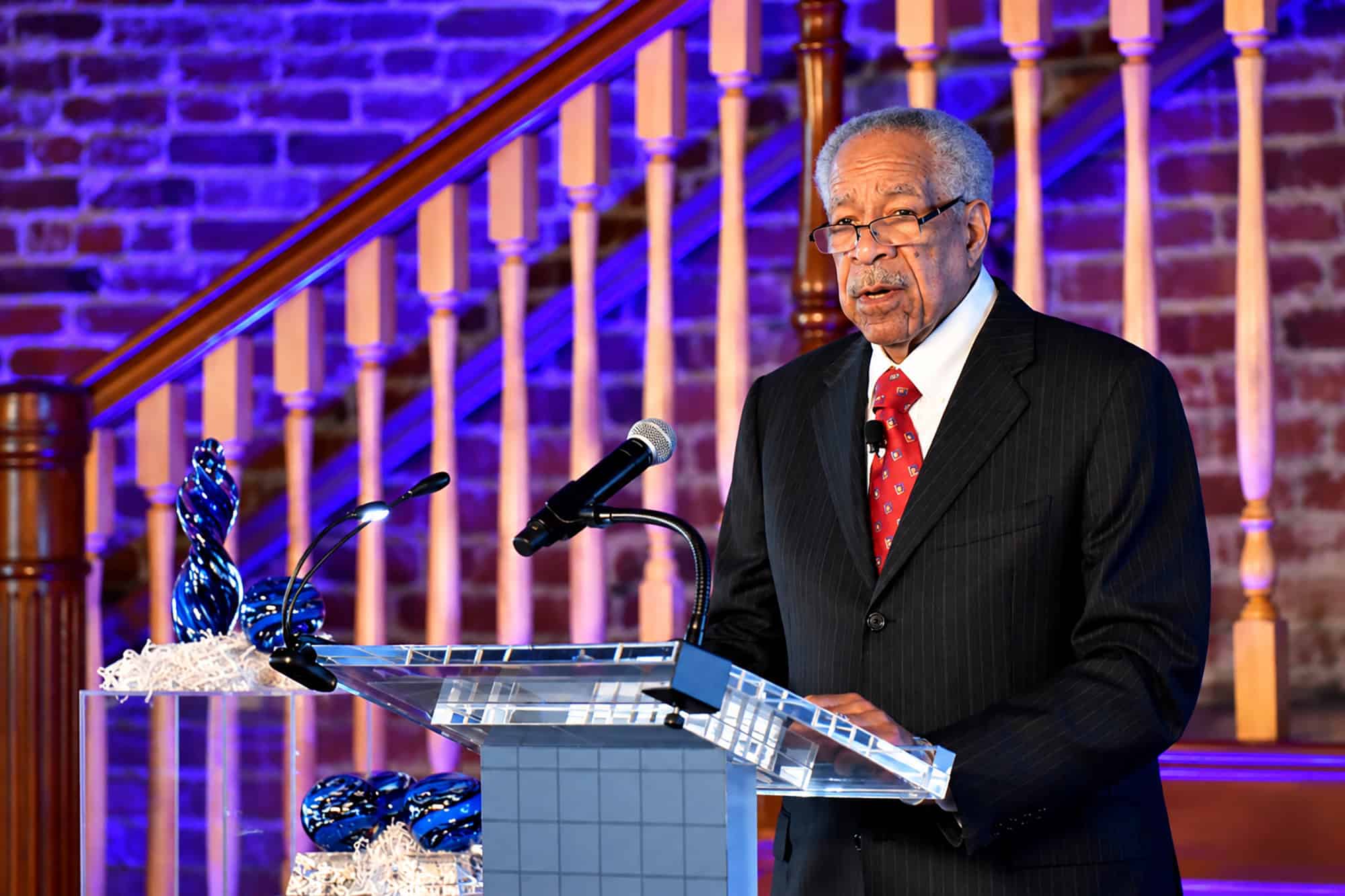
Lou Smith, former president and CEO of the Ewing Marion Kauffman Foundation, shares recollections about Mr. K, offering context behind the founder’s vision during a reveal ceremony for the Kauffman Uncommon Leader Visionary Award; photo by Tommy Felts, Startland News
In September, Lou Smith, a former president of the Ewing Marion Kauffman Foundation who helped shepherd the Royals donation and sale, credited Sherman’s work to keep the team in Kansas City despite adversity during an awards event recognizing uncommon leadership.
Smith drew a throughline between a series of iconic entrepreneurial leaders.
“Henry Ford once said, ‘Obstacles are those frightful things you see when you take your eyes off the prize,’” Smith told the crowd. “Well, Mr. K refused to listen to those who said it could not be done. He saw opportunity where others saw obstacles.”
Click here to read more of Lou Smith’s remembrances of Ewing Marion Kauffman’s leadership and its lasting impact
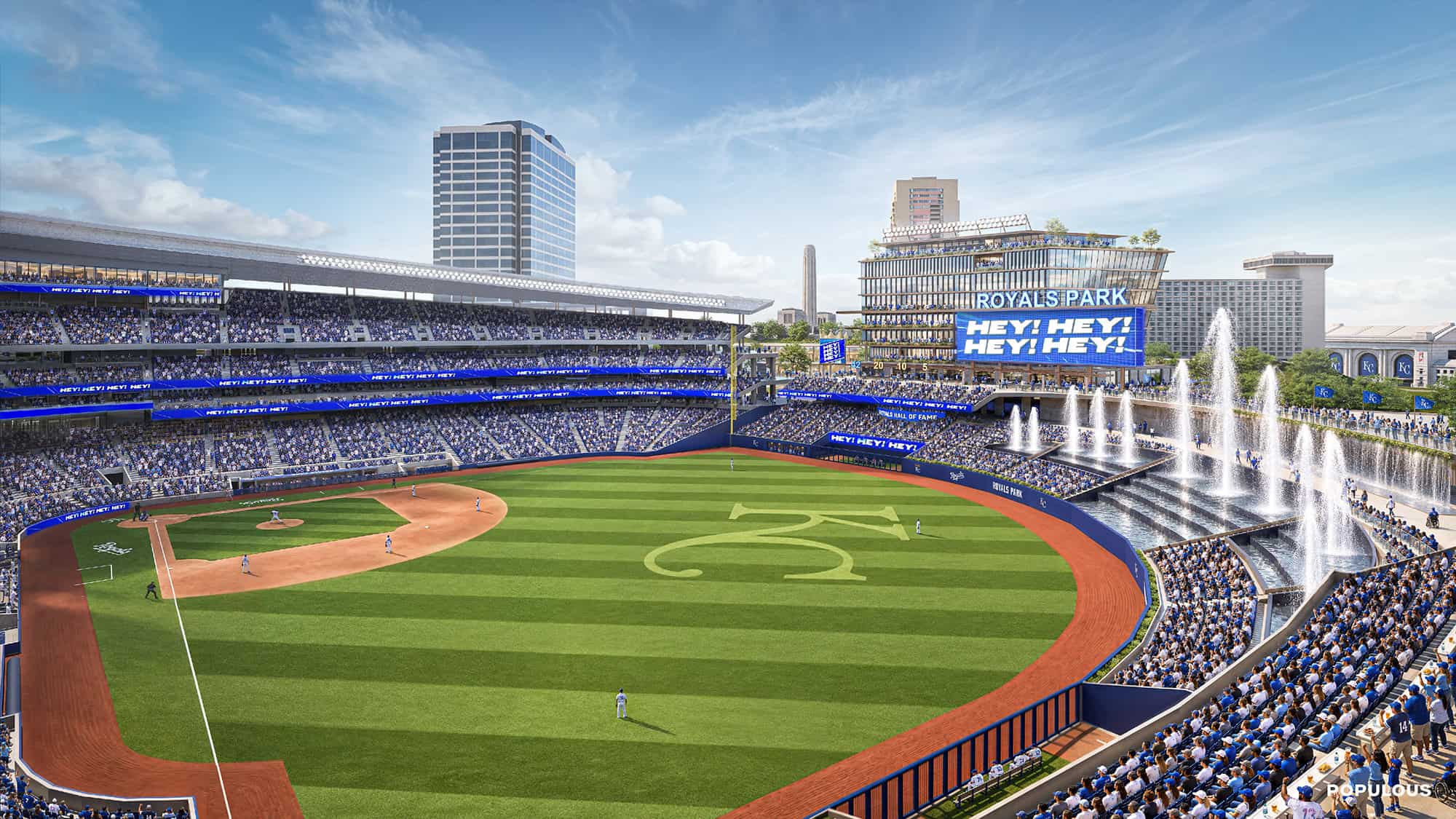
A rendering of the Royals’ new stadium at Crown Center reflects designer Populous’ plan to incorporate enhanced fan favorites and iconic views into the ballpark experience; rendering courtesy of Populous, the Kansas City Royals
‘It’s not something we can replicate anywhere else’
The new stadium and ballpark at Crown Center come as the latest in a series of transformational projects led by visionary Kansas City leaders, Santee said, citing decades of investments like the T-Mobile Center, Power & Light District, KC Streetcar, Current Landing, Kauffman Center for the Performing Arts, and Luminary Park.
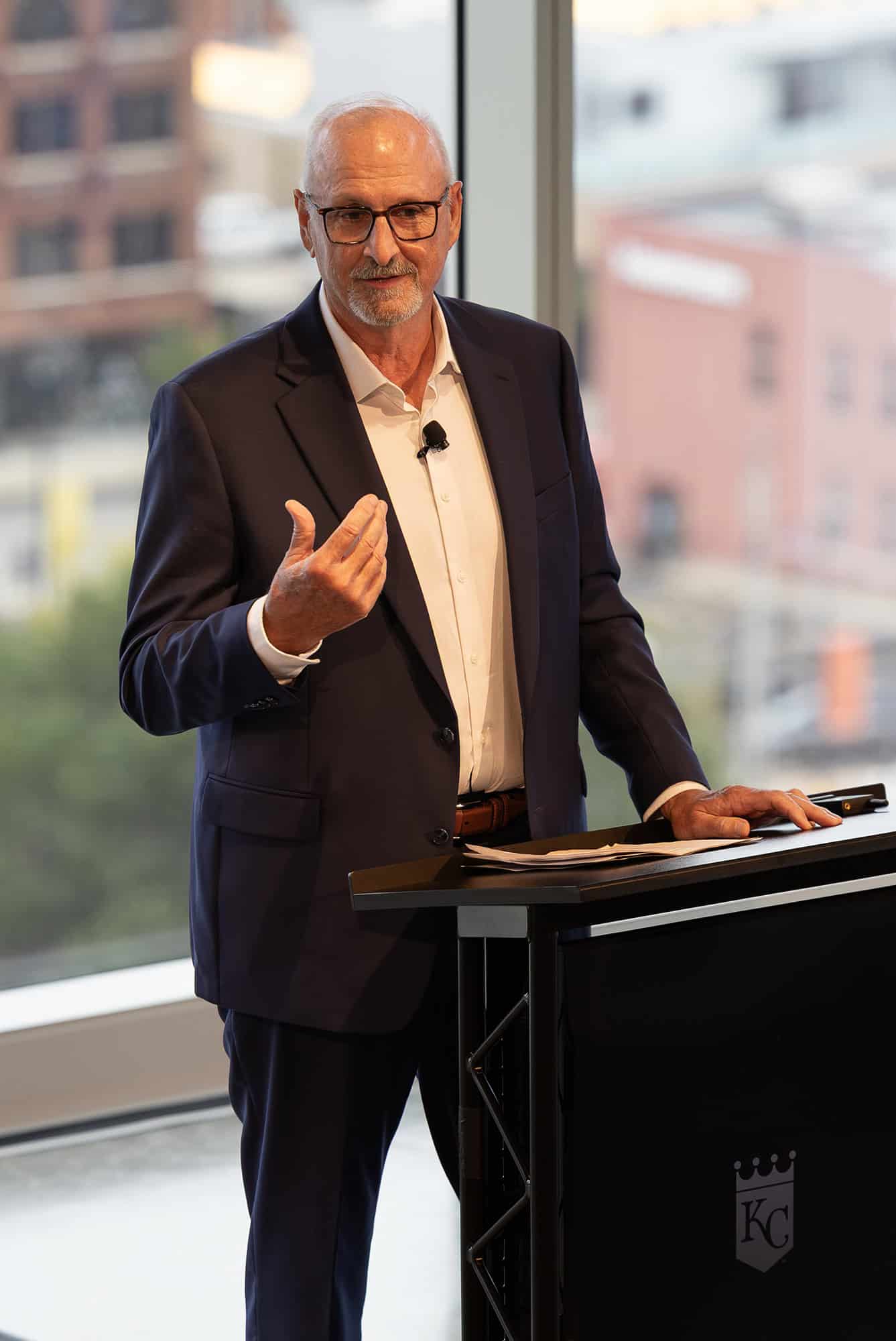
Earl Santee, senior principal and founder at Populous, offers insights into the design of the Royals’ new ballpark at Crown Center, emphasizing its ability to fit into the existing neighborhood amid iconic Kansas City landmarks; photo by Haines Eason
“This is the next step in that evolution,” Santee said, explaining plans to build on that momentum and join in the tapestry of development already taking shape. “We’re bringing a ballpark downtown; it’s in the heart of the city — and I have to be clear about this — it’s not an object in space; it’s an object in a neighborhood.”
That means rather than creating a whole new community around the ballpark, the Royals can enhance areas like Union Station, Crossroads Arts District, and Liberty Memorial, as well as the surrounding residential neighborhoods.
A core element of that integration, Santee said, involves encouraging physical transparency throughout the ballpark.
“This is not other sports. In baseball, we like transparency,” he said. “We want people to see into and out of the game itself.”
In addition to eye-catching fountains, a new 3-D CrownVision display and immersive experience, and intimate seating designed to get fans closer to the action, the ballpark is designed with a second, 360-degree concourse that allows fans to walk the whole way around the building, Santee said.
“There are a lot of amenities to the project that are a little different from The K, but they’re part of what makes this a modern day ballpark,” he said, referencing Kauffman Stadium.
Entrance at the top of the upper deck, with fans moving down into the new stadium also makes the ballpark more approachable, Santee emphasized.
“This building is only 38 foot tall on the south side, so when you walk up, it’s not imposing,” he explained. “Again, we want people to be invited into it. The transparency allows you to look into the ballpark; it allows you to look into downtown.”
With a seating a capacity of 34,000 with standing room for 3,000 more, the new stadium — nestled into the city’s limestone and surrounded by iconic views — offers something of a realization for the site once proposed for Signboard Hill.
“We want to connect the ballpark back to the city,” Santee said. “It’s not something we can replicate anywhere else.”
Fund More Stories
This story was made possible by readers like you. Join them — make a one-time contribution or become a monthly member to sustain our work.