Can a machine buy it? Why your business model might already say ‘legacy’
September 21, 2026 | Ryan Wright, Moment, Stand With Crypto

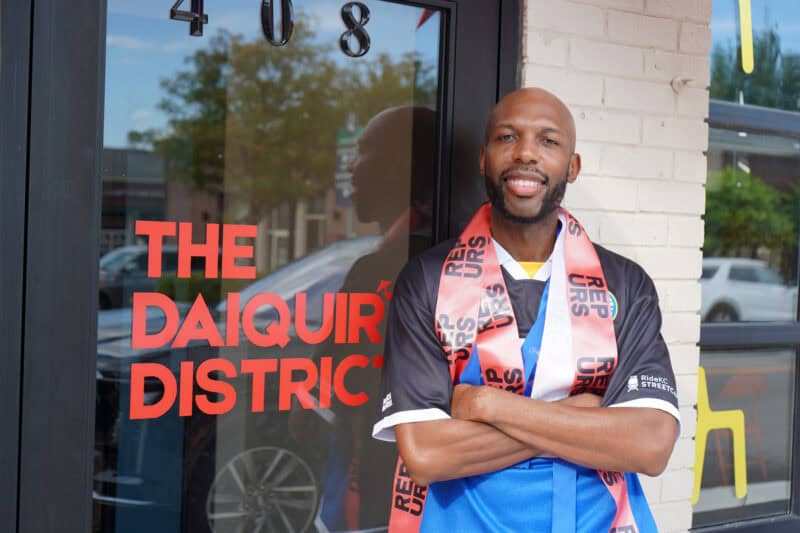
Ryan Wright, Moment, Stand With Crypto, Missouri; photo by Nikki Overfelt Chifalu, Startland News
Editor’s Note: The perspectives expressed in this commentary are the author’s alone. Ryan M. Wright is CEO of Nvlope, president of Stand With Crypto, Missouri, and founder of MOMENT (The Missouri Mission for Exponential Technology).
For roughly two decades, digital business has operated on a foundational assumption: a customer is a person or an organization. They browse websites, compare features, schedule sales demos, enter credit card details, approve invoices, and lock themselves into recurring subscriptions.
What changes when the customer is software?
An autonomous machine does not inherently need a login screen, a pricing page, an account manager, or an annual seat license. It does not browse or negotiate over lunch. It simply discovers a resource, evaluates its price and authenticity, purchases exactly what it needs in real time, consumes it, and moves on.
Consider a practical scenario: an AI agent needs three database rows, one model inference, and 400 milliseconds of compute right now. Forcing that machine through a sign-up form, a credit card prompt, and a $99-per-month enterprise tier isn’t just friction — it is a fundamental economic mismatch.
Collapse of the transaction unit
This transition is not primarily about cryptocurrency payments. It is about a structural shift in the minimum viable commercial relationship.
In the subscription era, bundling thousands of hypothetical interactions into a monthly fee was an economic necessity. Charging someone a fraction of a cent over legacy credit card networks made no financial sense once transaction fees, billing cycles, and administrative overhead were factored in.
When marginal transaction costs fall toward zero and settlement occurs programmatically, bundling shifts from a mandatory constraint to an optional packaging choice.
The profound change is not simply that software can pay. It is that the smallest economically viable customer relationship is collapsing from a year or a month down to a single HTTP request lasting milliseconds and costing fractions of a cent. That is the conceptual bridge between traditional SaaS metrics and agentic commerce.
Emerging machine commerce stack
This infrastructure is not a theoretical forecast — it is being assembled and deployed in production today:
- Identity and Reputation (ERC-8004): Authored by contributors from MetaMask, the Ethereum Foundation, Google, and Coinbase, ERC-8004 establishes persistent identity and reputation registries for software agents. Community tracking reports over 14,000 registered agents across 21 blockchain networks following its Ethereum mainnet launch.
- Authorization (AP2): Google’s Agent Payments Protocol solves the critical delegation challenge, providing cryptographically verifiable mandates that an agent is authorized by a human or enterprise to make specific purchases.
- Commerce Protocols (UCP): Developed by Google and Shopify, the Universal Commerce Protocol standardizes how agents and merchants communicate across product discovery, checkout, and post-purchase activities.
- Autonomous Payments (x402): Reclaiming HTTP’s long-dormant 402 Payment Required status code, x402 embeds native payments directly into web requests. Protocol dashboards report approximately 75 million transactions and $24 million in volume over the trailing 30 days, spanning 94,000 active buyers and 22,000 sellers. In July 2026, the Linux Foundation officially launched the x402 Foundation to govern the protocol alongside partners like Coinbase, Google, AWS, Circle, and Mastercard.
The distinction between these layers defines the new stack:
- ERC-8004 answers: Who is this agent?
- AP2 answers: Is it authorized to spend?
- UCP answers: What is being bought and how does commerce flow?
- x402 answers: How does economic value move instantly?
Identity, authorization, commerce, reputation, and payment are converging into a standardized, machine-native web layer.
The “Brochureware” moment for AI
When the early web arrived, companies uploaded static brochures online, treating the internet as a new place to display old offline workflows. The dominant internet companies understood that the web changed the structure of the transaction itself.
Many leadership teams are repeating that mistake today. They are adding AI chatbots and internal copilots while leaving untouched the deeper assumption that every commercial relationship begins with a human.
A business isn’t legacy because it charges a subscription. It becomes legacy when a machine wants to buy its product and the company can only explain how a human can subscribe to it.
An authoritative answer as a metered service
This shift fundamentally alters how high-value data and digital assets are monetized. x402 provides payment execution, while identity and authorization protocols supply the trust and verification signals.
 Together, they make a new commercial category possible: the authoritative answer as a metered service.
The open web is increasingly saturated with synthetic slop, automated scraping, recycled material, and deliberate model poisoning. An autonomous agent making financial, legal, medical, or supply-chain decisions cannot treat every unverified source as equal. Once machines can pay autonomously, trusted information becomes directly monetizable at the exact moment of decision:
- A logistics agent paying a port authority for a verified, real-time congestion reading.
- A financial agent purchasing an authoritative corporate filing rather than scraping a third-party repost.
- A healthcare research agent paying for a provenance-backed, audit-ready dataset.
- A procurement agent paying for real-time inventory verification or instant certification.
- An AI assistant paying for one licensed answer from a specialist source instead of relying on an uncertain summary.
The machine is not paying because information is scarce; it is paying because certainty is valuable.
Machine shelf space and the SaaS inversion
Businesses will soon compete for machine discovery much as they competed for search rankings, Amazon shelf space, or app store placements. A human-facing website asks: Can the customer understand us? A machine-facing endpoint asks: Can an autonomous system discover us, evaluate our trust signals, verify authorization, determine price, transact, and consume the result without human intervention?
The next storefront may not have a homepage. It may have an endpoint.
| Dimension
Target Buyer |
Legacy SaaS Model
Human with credit card / procurement authority |
x402 / Agentic Model
Autonomous software agent with wallet access |
| Pricing Unit | $99/user/month recurring seat license | $0.004 per query or outcome-based micro-fee |
| Discovery Channel Competitive Moat | Search ads, outbound sales, app marketplaces
High switching costs and brand lock-in |
Programmatic HTTP status pings and machine registries
Machine readability, low latency and data provenance |
Subscriptions will not disappear — x402 V2 natively supports subscription-like structures, and predictable capacity will always retain value. But ARR and MRR will cease to be the unquestioned default architecture of digital revenue.
SaaS spent 20 years turning variable software usage into predictable subscriptions. Recently, AI infrastructure has pushed that forward: massive future compute and data-center capacity is contracted years ahead, turning anticipated consumption into present commercial value.
Agentic commerce points in the opposite direction. It sells the granular reality: this inference, this dataset, this verified answer, this specific outcome. No seat required. No annual contract necessary. No forced packaging around a transaction that only needs to happen once.
Eventually, CFOs will track another core metric alongside ARR: machine-generated revenue. That represents commerce measured by what actually occurred, rather than what a human promised would happen.
An executive diagnostic
If an autonomous software agent arrived at your company tonight with authority to spend $20, could it buy anything from you?
Could it:
- Discover what you sell?
- Establish what it costs?
- Verify that you are trustworthy?
- Confirm it is authorized to purchase?
- Pay you instantly?
- Receive the product?
- Document the transaction?
- Move on without a human ever intervening?
For most enterprise businesses today, the answer is no.
That is understandable for a transitional period. But Google, Coinbase, Shopify, Mastercard, Visa, Walmart, and Target are already building the foundation for a world where that answer becomes yes.
If your answer remains no for too long, the problem may not be your AI strategy. It may be your business model.
The question is no longer simply whether AI will automate work — it is whether your company has anything an AI agent can buy.
 Moment is the expert-led business league that helps Missouri leaders safely navigate the convergence of AI and blockchain — so your organization doesn’t just adapt to the new digital economy, it commands it.
Selected Sources
The Guardian. From Shrimp Jesus to Erotic Tractors: How Viral AI Slop Took Over the Internet.
Google Cloud. Announcing Agent Payments Protocol (AP2).
Google Developers. Universal Commerce Protocol (UCP).
Fund More Stories
This story was made possible by readers like you. Join them — make a one-time contribution or become a monthly member to sustain our work.