KC ranks No. 11 among Midwest startup hubs; why it needs its own big news day to get VCs’ attention
August 12, 2026 | Tommy Felts
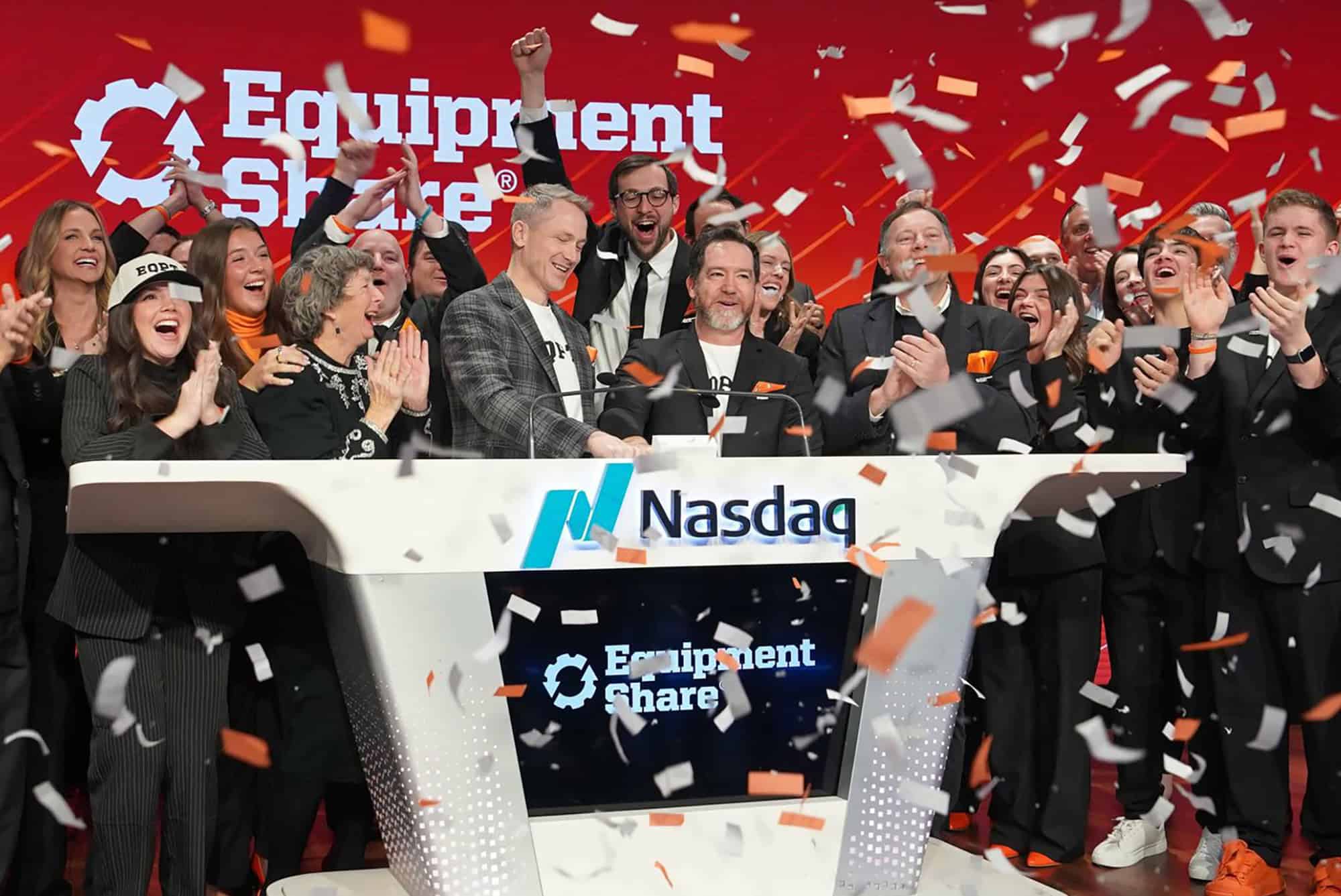
EquipmentShare co-founders Willy Schlacks and Jabbok Schlacks are joined by their team in January as the Columbia-based company begins trading on the Nasdaq Global Select Market under the ticker symbol “EQPT." The moment — the largest Midwest tech IPO M25 has covered in its annual startup city rankings — sparked Columbia's five-point jump in the Midwest report, from No. 22 to No. 17. Kansas City sits at No. 11 in 2026, but its most-recent big wins registered in 2022, M25 reports; photo courtesy of EquipmentShare
Investors are looking for more big outcomes — from billion-dollar valuations to IPOs — and plentiful startups in the pipeline behind them, said Victor Gutwein, delivering the verdict on Kansas City for his firm’s 2026 ranking of Midwest startup cities. Cues from KC’s most competitive neighbors could help it move up the list, he added.
“It has been a genuinely strange 12 months to be watching capital markets, and the Midwest has felt every bit of the whiplash,” said Gutwein, managing partner for the influential Chicago venture capital firm, M25.
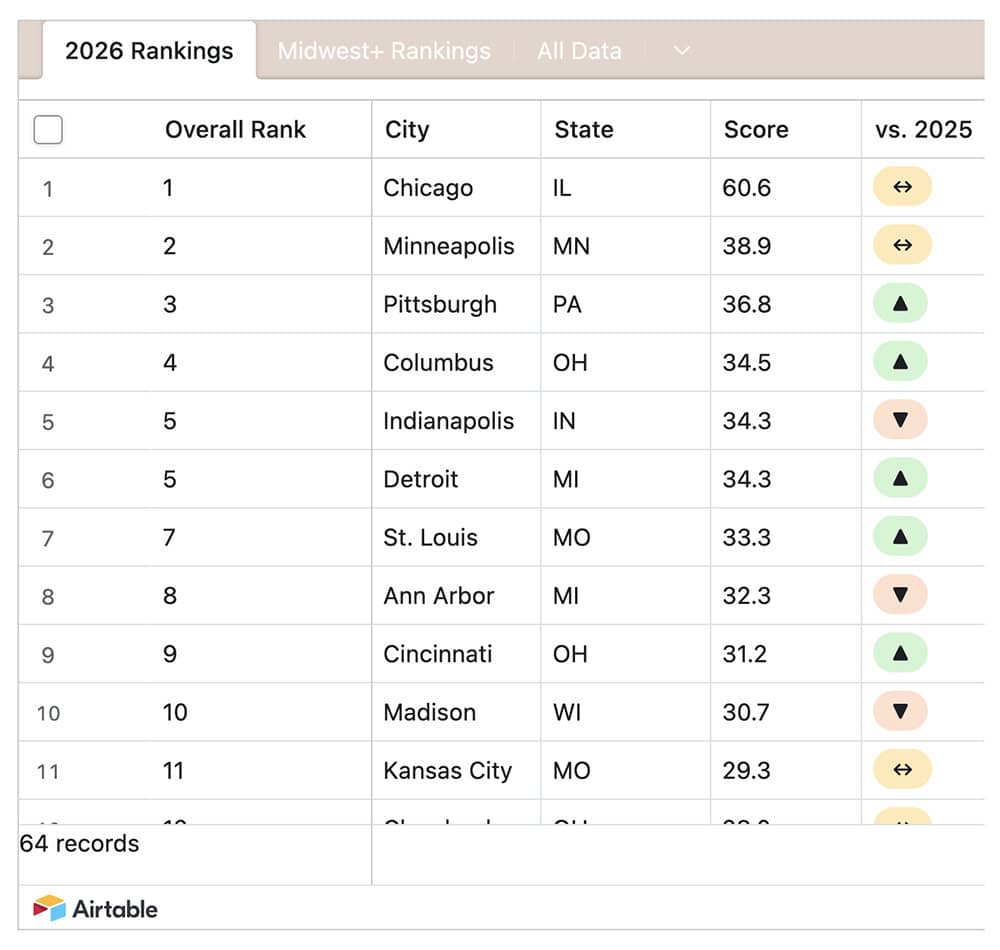
M25 this week released its annual Best of the Midwest: Startup City Rankings report, a deep dive into how 64 startup hubs — including micro-environments like Wichita (No. 27), Springfield (39), Manhattan (41), and Topeka (49) — are performing; ranked using data tied to startup activity, access to resources, and business climate.
“The Midwest’s exit window is opening for real, its funds keep getting bigger, and its biggest new outcome this year came out of Nebraska, of all places,” Gutwein said, referencing Lincoln-built CompanyCam’s $2 billion valuation. “We remain as convinced as ever that this region’s moment is not a one-year story.”
Kansas City notched the No. 11 spot, a position it’s held since 2022.
In past years, that looked like stagnation, Gutwein acknowledged previously, but holding the spot in 2026 is laudable, he said — citing a broad upswing in Midwest startup activity and volatile changes to levels of state support across the region.
How’d KC do it?

Victor Gutwein, M25
While Kansas City’s ranking remained the same year over year, its behind-the-scenes score jumped from 24.1 to 29.3, using M25’s weighted calculations. The improvement is credited largely to a $70 million Series B raise for Lead Bank (now valued around $1.47 billion, Gutwein said) — a trigger that actually pushes KC’s “Big Outcomes” score ahead of St. Louis’ (with the overall No. 7 rank).
For context, Kansas City’s last $50 million-plus raise before Lead Bank was PayIt’s $90 million growth round in 2022, Gutwein said, and the last major exit tracked by M25 in Kansas City was RxSavings Solutions in late 2022.
“Now, that trend is similar for a lot of Midwest cities because 2021 to early 2022 was a peak in VC funding everywhere, and most of the Midwest hasn’t experienced the major AI/robotics/defensetech booms that more coastal hubs (and Austin) have had recently,” he noted.
A 2026 increase in Kansas City startup formation — from 217 to 242 — also helped move the needle for the region, he said, but it’s still a critical area in need of improvement.
“What’s holding Kansas City back is basic: KC still has fewer total startups than the cities around it,” Gutwein said. “Kansas City sits at 242 on Pitchbook right now versus 345 in St. Louis, and that’s our single most heavily weighted input in the whole model, worth 20% of a city’s score.”
“That gap matters more than any variable.”
Kansas City’s accelerator and incubator scene has also “gone quiet,” he added, comparing the ecosystem of 2026 with years past when KC boasted distinct Techstars and Fountain City Fintech programs, among others, and had far more venture-backed seed and Series A rounds.
“It doesn’t mean nothing is happening, but it’s harder to feel (and measure) signs of growth and success,” Gutwein said.
Long story short: A major funding round outweighed other factors for 2026 and kept Kansas City ticking up, but it ultimately looks like a wash on the M25 rankings because — while the KC region got a boost — competitive hubs in Madison, Wisconsin, Cleveland, Ohio, and Louisville, Kentucky, also improved at a similar pace.
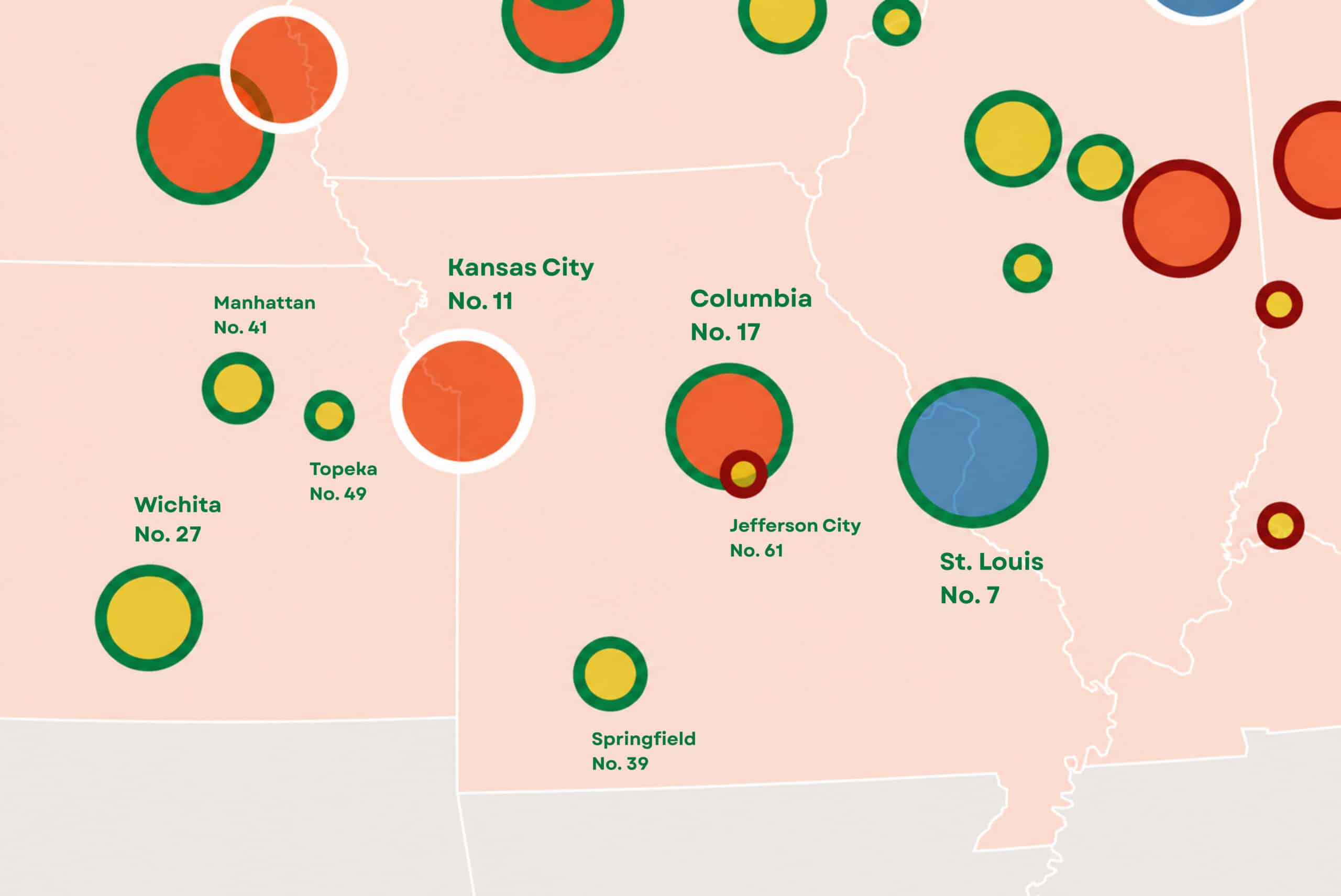
Zooming in on Missouri, M25’s startup city rankings reflect activity across the Show-Me State; image courtesy of M25
Border-to-border activity
M25 earlier this month announced the addition of a new venture partner from Missouri: Tom Stemm, the exited founder of Ryvit. It’s the firm’s second such partner in St. Louis, where M25 is doubling down on the opportunity to identify and back the next wave of Missouri unicorns using experienced entrepreneurs who already know the ecosystem and the capital game.
Kansas City struggles to outperform its high-profile sister city to the east in M25’s appraisal, largely because of lagging startup density. St. Louis also has a modest edge in the number of active venture capital firms and in total exits, Gutwein said, noting the widest gap between the cities is accelerator activity — where St. Louis excels — though the programmatic entrepreneur support data point is not weighted nearly as high as Big Outcomes.
And that’s where Columbia — midpoint of the cross-state I-70 rivalry — steals the show.
When Columbia-built EquipmentShare IPO’d on the Nasdaq in January, raising $747 million, it became the largest Midwest tech IPO M25 has covered in its rankings. It also helped the mid-Missouri college town jump five spots — from No. 22 in 2025 to No. 17 in 2026 — in the firm’s latest report.
ICYMI: EquipmentShare hits Nasdaq; Missouri unicorn says its staying true to its long-term vision
“One event like that can move a city’s whole Big Outcomes score more than years of smaller activity combined, which is exactly what happened here,” said Gutwien. “I’m excited to see what comes out of it.”
“I already know it has directly caused Redbud, an accelerator turned successful preseed fund, to raise multiple funds and I’m sure we’ll see EquipmentShare talent start other companies, angel invest, and further impact the CoMo tech community,” he added.
RELATED: Missouri notched big wins for entrepreneurs in 2026, but work remains, advocates report
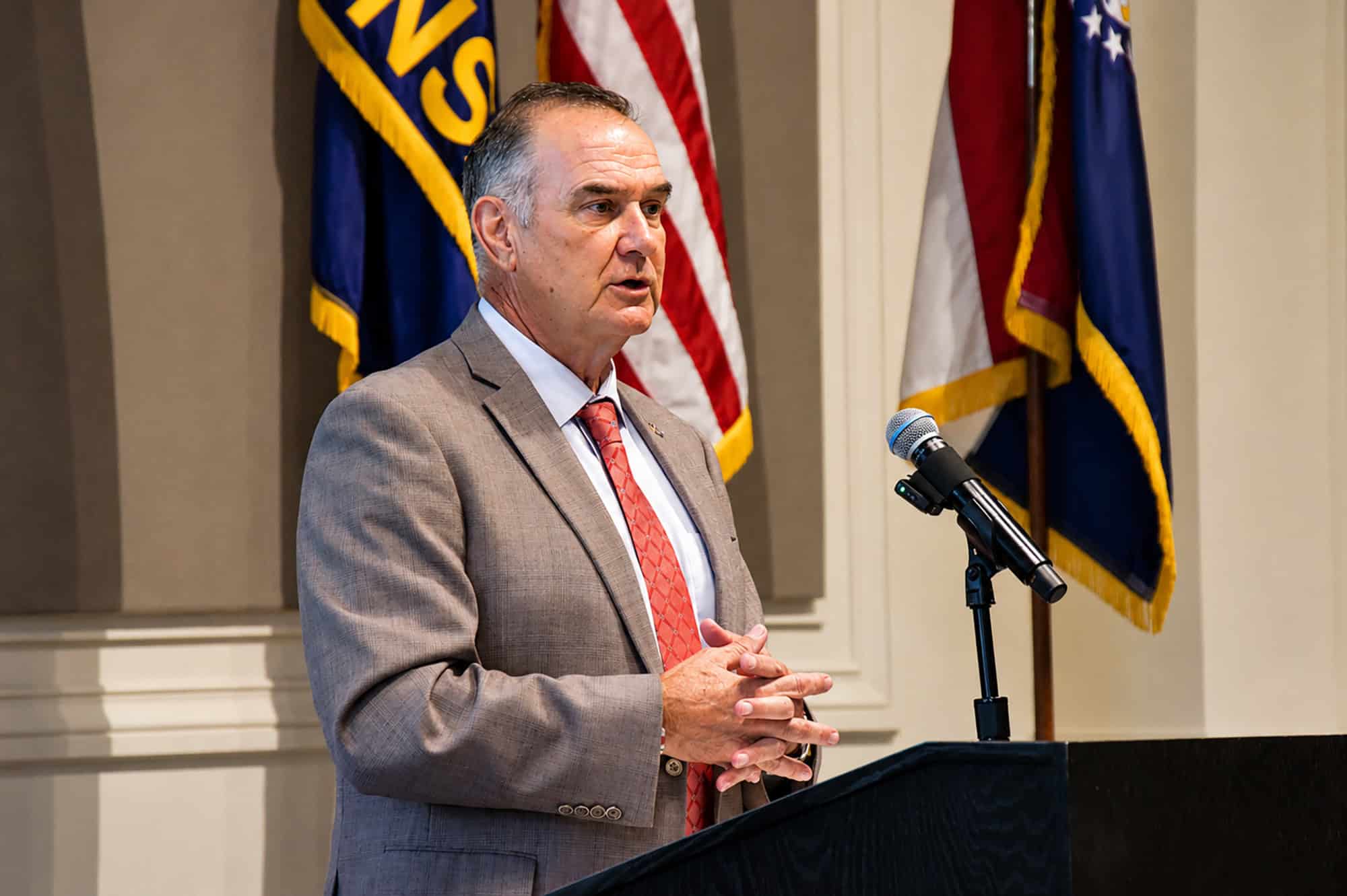
Missouri Gov. Mike Kehoe speaks in July about state investment in innovation during a KC BioHub announcement event at Union Station; photo by Tommy Felts, Startland News
Government glow isn’t a given
Startup support at the federal and state levels can change with the political winds, Gutwein noted, pointing to angel tax credit movements in Kansas and Missouri that could help reshape the rankings in the coming years.
“Kansas dodged a bullet,” he explained. “The state’s angel tax credit was on a path to sunset after tax year 2026, flagged in a legislative audit late last year. Gov. Laura Kelly signed a fix in April, extending the sunset to 2031, adding a rural set-aside, and raising the annual cap to $8 million.”
“Not a new program so much as a save, but a meaningful one given how close it came to expiring outright,” Gutwein added.

Jason Wiens, coalition director of NEXT Missouri, discusses big wins at the Missouri Statehouse for entrepreneurs during a June town hall event organized by Right to Start and Missouri Starters Coalition; photo by Nikki Overfelt Chifalu, Startland News
On the Show Me State side of the border, Gov. Mike Kehoe notably signed into law Missouri’s own angel investor tax credit, but not in time to register for the 2026 ranking. (The $6 million offset program takes effect in tax year 2027.)
Impacts from other big headlines in the region also have yet to be seen, Gutwein said, reacting to news of Kansas City’s recent federal grant awards to strengthen the region’s biomanufacturing and critical materials hubs and infrastructures.
It’s far more difficult to assess the kinds of ripple effects the Kansas City startup ecosystem could see from such funding events, he said, drawing contrast to government programs like state tax credits and direct investment funds.
“Grants like these tend to have a long tail, it can be years before they show up as actual company formation or funding rounds in our data, and they’re not typically immediate software job creators the way a $50 million raise is,” Gutwein said, noting the challenge in trying to standardize, quantify and classify outcomes, from a city-to-city perspective, linked to projects like Tech Hubs and National Science Foundation-driven initiatives.
“That doesn’t mean they don’t matter, they can genuinely seed the next generation of spinouts, we just won’t see it in the numbers for a while,” he added.
Fund More Stories
This story was made possible by readers like you. Join them — make a one-time contribution or become a monthly member to sustain our work.