Analysis: Is AI eating tech? Traditional entry-level jobs are disappearing with KC at ground level
July 9, 2026 | Haines Eason, Freelance Kansas
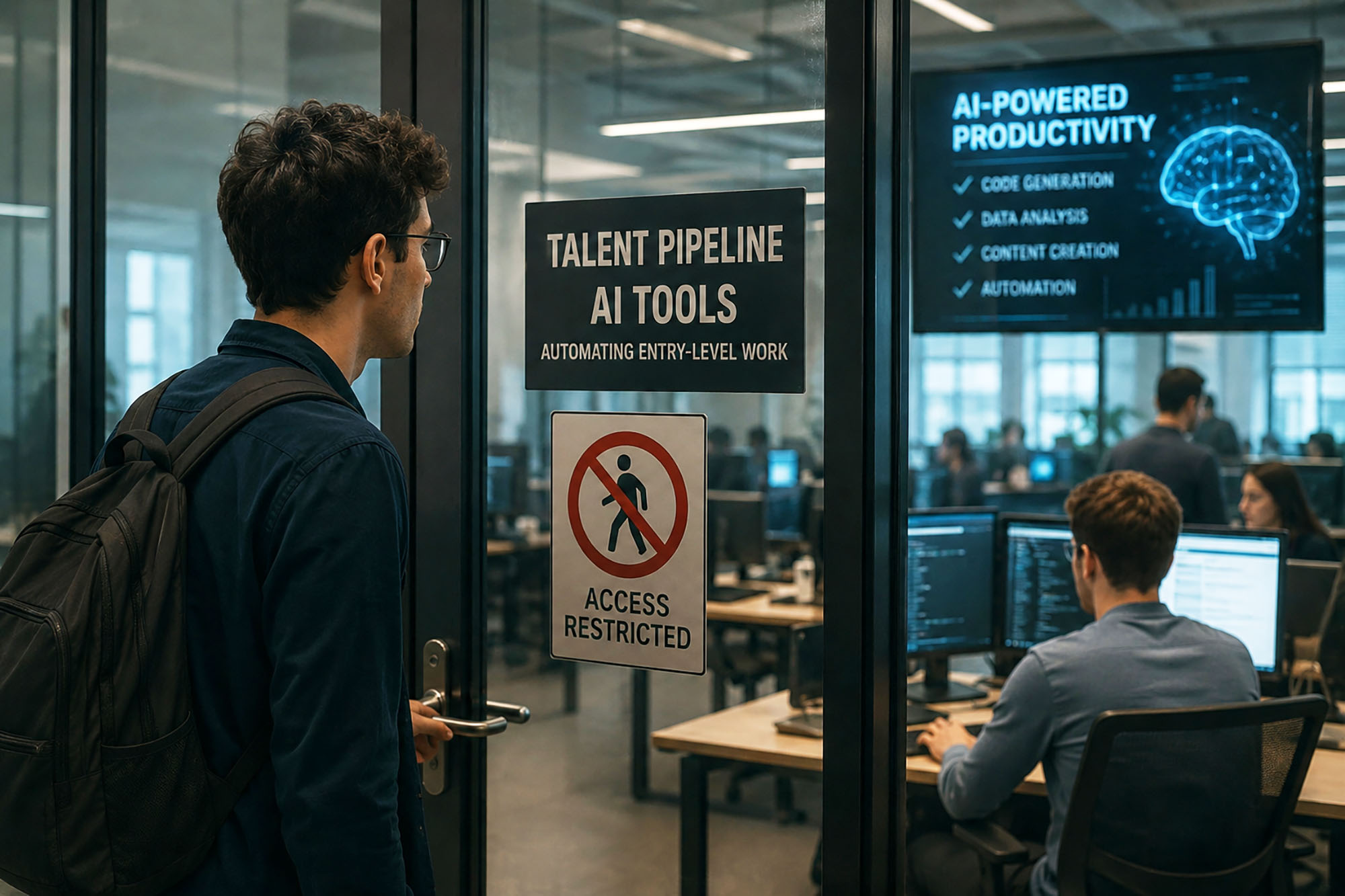
An AI-created rendering depicts an entry level tech worker restricted from the tech workforce
Editor’s Note: The following look at Kansas City’s tech workforce is the second part of a two-part analysis produced from interviews with educators, recruiters and economists.
Kansas City’s tech sector is under new pressure with a consistent picture emerging: traditional entry-level career pathways — the hands-on, lower-risk work that once trained new talent — are shrinking or disappearing altogether.
The result is a quiet but consequential shift, experts told Startland News. Companies still need talent. Training programs are still producing it. But the bridge between the two is breaking.
The disappearing on-ramp
For years, the tech industry relied on a familiar model: Junior workers handled routine tasks, learned on the job and gradually moved up. That foundation is eroding.
“With the rise of automation… there’s fewer of those roles because the manual work itself has gone down,” said a Midwest-focused recruiter who fills technical contract roles across regional markets, including Kansas City. The recruiter requested anonymity to discuss hiring practices candidly.
Tech’s “manual tasks” — once assigned to entry-level workers — are increasingly handled by software, scripts or AI-assisted tools. Even before generative AI, automation had already reduced the need for junior-level labor. AI has accelerated the trend.
The causes vary, but the effect is similar: fewer low-risk roles where new workers can gain experience.
Offshoring has compounded the shift. Roles like help desk and basic IT support, once a common starting point, have increasingly moved overseas.

Matt Sharples, TriCom; courtesy photo
“We are seeing fewer true entry-level roles,” said Matt Sharples, founder and CEO of Leawood-based TriCom. “Offshoring and nearshoring … had an effect because that was a good starting point for many getting into IT.”
The outcome isn’t a dramatic collapse in hiring. It’s something subtler: the slow removal of the bottom rung of the ladder.
What qualifies as “entry-level” has also shifted. Recruiters say companies are increasingly treating the term less as “new to work” and more as “new to a specific technical domain.”
In practice, that often means candidates are still expected to arrive with workplace experience, communication skills and the ability to operate inside modern business environments — even if they lack years of direct technical experience.
“It’s no longer somebody that’s just coming right out of school,” the recruiter explained. “Entry-level now often means new to a domain — not new to work itself.”
Hiring has changed quietly, and few are talking about it
At the same time entry-level work is shrinking, hiring expectations are rising. Companies aren’t broadly building talent pipelines. They’re targeting specific, immediate needs.
At the same time, employers are becoming more specific — and less flexible — in what they want from hires. Recruiters describe a growing number of companies searching not for broadly capable technologists, but for candidates who can immediately solve one narrowly defined problem inside an existing team or workflow.
“We have this implementation or we have this project that we’re doing and we have one skill gap on our team that we need to plug in,” the recruiter said, describing conversations with hiring managers. “You have to have all this experience to get in the door, but to actually get the job, you have to have this very specific thing.”
Sharples sees a similar pattern, calling it “bullseye hiring,” where employers prioritize candidates who already have exact technical experience rather than developing new talent.
Remote work has expanded the available talent pool, allowing companies to recruit experienced workers from outside their immediate markets. In Kansas City, that shift has been significant.
Sharples said his firm found that roughly 40 percent of local IT professionals were working for companies not based in the region, a trend that has reshaped hiring behavior.
But that expanded reach has also reduced the incentive to train locally.

Kevin Grawe, Centriq; courtesy photo
“It’s not their job to build the workforce,” said Kevin Grawe, owner of Kansas City-based Centriq Training.
That mindset is becoming more common — and more consequential. The outcome isn’t a dramatic collapse in hiring. It’s something subtler: the slow removal of the bottom rung of the ladder.
The pipeline paradox — finally, there’s talent, but are there jobs?
On paper, Kansas City isn’t short on aspiring tech workers.
Training programs continue to graduate students. Career switchers are entering the field. Applications for entry-level roles are abundant.
“Anytime somebody goes to apply… there’s 300 resumes that flood that employer,” Grawe said.
The problem isn’t supply, it’s conversion. Grawe said placement has become increasingly difficult — especially in software development.
“We were struggling to get entry-level developers jobs… we couldn’t place students,” he said.
That dynamic has forced some programs to rethink their offerings entirely, scaling back or restructuring training tracks that no longer reliably lead to employment.
Meanwhile, employers continue to report difficulty finding talent — particularly at the mid-level and senior tiers.
The result is a mismatch that hasn’t resolved itself: a crowded entry point with fewer openings, paired with ongoing demand further up the ladder.
AI is compressing the ladder
Artificial intelligence is amplifying these trends in ways that are still unfolding. In some cases, it’s replacing the types of tasks that once defined entry-level work. In others, it’s shifting expectations for what “entry-level” even means.
“I would agree that for the software development role this is true,” Grawe said, referring to the decline in junior-level work. “Mid-level and senior level developers have the ability to automate coding and testing with AI tools that used to be performed by entry-level developers.”
That compression effect has ripple consequences.
If experienced workers can handle more output with fewer people — or fewer junior contributors — the need to bring in new talent diminishes. At the same time, companies are placing greater emphasis on skills that are harder to automate.
“I believe companies are leaning toward hiring candidates that have more of the human skills… more than just certification and being able to write code,” Grawe added.
The bar hasn’t just moved. It’s changed shape.
Why Kansas City is a canary in the mine
Such shifts are happening nationally, but Kansas City has its own dynamics that intensify the effect.

Jeremy Hill, Federal Reserve Bank of Kansas City
Wage disparities are one factor. According to data analyzed by economist Jeremy Hill, tech workers in the Kansas City metro earn significantly less than the national average for comparable roles.
“It’s a bargain for the employer, but it’s not an opportunity for the household,” Hill explained.
Remote work has made that imbalance more visible — and more actionable. Workers can stay in Kansas City while earning higher wages elsewhere, reducing reliance on local employers.
At the same time, major corporate shifts — including the ripple effects of Cerner’s acquisition by Oracle — have introduced volatility into the local labor market, temporarily increasing supply and altering hiring dynamics.
Taken together, those factors make Kansas City a useful lens into a broader transition: a market with strong talent, steady demand and a growing disconnect between the two.
What comes next? No expert has an answer
No one interviewed for this story claims to have a precise answer.
Some see the current moment as part of a broader cycle that will eventually rebalance, dot-com-bubble style. Others believe the changes are structural — a permanent reshaping of how tech work is organized and staffed.
What is clear: the old model is under strain. The traditional pathway — learn the basics, get a junior role, build experience and move up — is no longer as reliable as it once was.
Broader labor data suggests the shift isn’t isolated to Kansas City.
According to LinkedIn’s 2026 Grad’s Guide, entry-level hiring is down 6 percent year over year — a smaller decline than mid-level roles, but still part of a broader slowdown. At the same time, nearly half of Gen Z workers say a lack of professional network is their biggest barrier to landing a role, and more than one in five are creating their own opportunities through side projects or businesses.
The data points to a labor market that hasn’t stopped hiring — but is becoming harder to enter through traditional paths. Companies are still hiring. Workers are still training. But the system that once connected the two is being rewritten in real time.
And for those trying to enter the field, the question is no longer just how to learn the work: It’s whether there’s still a place to start.
Fund More Stories
This story was made possible by readers like you. Join them — make a one-time contribution or become a monthly member to sustain our work.