KC Tech Council’s plans for $4M Kauffman grant: ‘We don’t want to publish another workforce playbook that sits on a shelf’
September 11, 2026 | Tommy Felts

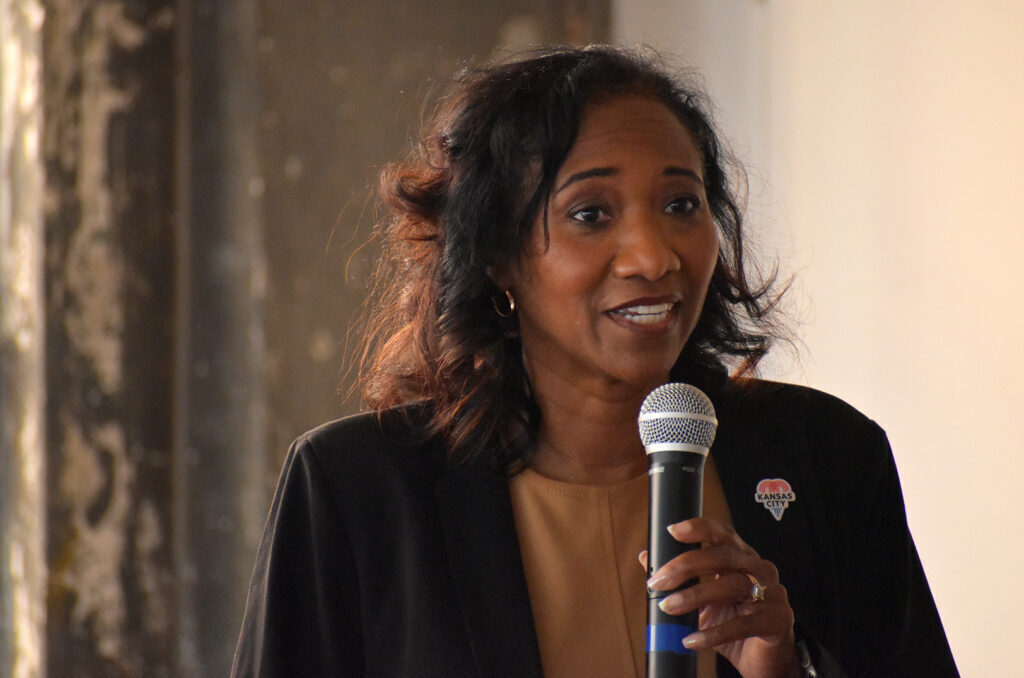
Kara Lowe, KC Tech Council; courtesy photo
Kansas City doesn’t have a broken tech pipeline, said Kara Lowe: the region is instead facing a talent connectivity problem. A just-announced $4 million project grant from the Ewing Marion Kauffman Foundation is expected to help the KC Tech Council plug that disconnect.
“The idea came directly out of our TechBridge planning work,” said Lowe, president and CEO of KC Tech Council (KCTC), referencing the KC TechBridge initiative launched by her organization in 2025 to work directly with Kansas City employers to build more effective, skills-based hiring practices for regional tech talent seeking their first job in the industry.
“We heard the familiar refrain that Kansas City needs more tech talent, but when we looked more closely, we found a different problem: There is significant talent and training infrastructure here, but the connection between qualified people and actual jobs is much more fragmented than it should be.”
 For example, KCTC found more than 10,500 unique job titles across roughly 17,000 tech job postings, she said, and 75% of those titles appeared only once.
“That kind of noise makes it harder for candidates to understand opportunities, harder for educators to know what employers actually need and, frankly, harder for employers to find the people they need,” Lowe told Startland News.
Grant funding from the Kauffman Foundation allows KCTC to establish a Technology Hiring Center of Excellence, which the tech council leader framed as a shared employer capability for tech companies across the region that are facing new workforce realities.
“The Center of Excellence will bring a market-representative group of employers together to identify those friction points, co-design better approaches and then actually test them,” she continued. “That could mean clearer job descriptions and job architecture, skills-based hiring practices, better interview and assessment models, or changes to hiring processes that take advantage of AI efficiencies without losing the human connection.”
“Importantly, we don’t want to publish another workforce playbook that sits on a shelf,” Lowe emphasized. “We want employers to test practices, measure whether they improve things like time-to-fill, quality of hire and retention, and then help successful approaches spread through the market.”

Allison Greenwood, chief impact and strategy officer for the Ewing Marion Kauffman Foundation, left, poses a question to panelists during a November 2025 GEWKC conversation on “Understanding Entrepreneurship-Centered Economic Development Capital” at Union Station; photo by Tommy Felts, Startland News
The $4 million grant is part of the Kauffman Foundation’s broader commitment to strengthening the systems that shape economic mobility across Kansas City, the foundation said in a press release. (Kansas City-based Phoenix Family also was awarded $3 million over three years to expand an employment support model that helps families navigate barriers to work and economic mobility.
RELATED: Two grants aim to create stronger pathways to economic mobility
Additional project grant opportunities are expected to open later this fall.
Technology jobs span nearly every sector of the Kansas City regional economy, offer above-average wages and increasingly provide multiple pathways to entry, making them a key driver of economic mobility for the region.
“These investments also reinforce something we’re seeing more clearly across our work: the systems that shape economic mobility are deeply connected,” said Allison Greenwood, chief impact and strategy officer at the Kauffman Foundation. “Education, workforce and entrepreneurship do not operate in separate lanes, and neither do the challenges people encounter as they build their futures.”
“What we learn through one strategic priority or grant pathway can strengthen our understanding of another,” she continued. “That gives us more opportunities to connect ideas, invest in promising approaches at the right scale and help build a stronger regional ecosystem for economic mobility.”

George Brooks, co-founder of Crema and KC Tech Council board member, and Kara Lowe, CEO of the KC Tech Council, unveil the KC TechBridge initiative in March 2025 at CPKC Stadium. A new $4 million project grant pushes the initiative further. “Finding great talent isn’t the hard part; it’s whether our hiring processes are built to recognize it. This grant lets us fix that connection point,” said Brooks. “When employers align on clearer, skills-based hiring practices, we turn Kansas City’s talent pipeline into a talent pathway.”; photo by Tommy Felts, Startland News
Lowe sees KCTC work through KC TechBridge as an expansion of what it means to advocate for Kansas City’s tech industry.
“KC Tech Council’s job has always been to listen to employers, understand what is constraining their growth and determine where an industry organization can uniquely help,” she said. “Sometimes the answer is public policy. Sometimes it’s convening the right leaders. Sometimes it’s telling the story of Kansas City’s tech economy. And increasingly, the workforce has required us to do more than simply talk about the problem.”
In 2021, KCTC launched a partnership with Apprenti designed to cultivate tech skills and offer first-hand experience for apprentices. That program set in motion a new approach that continues through KC TechBridge, Lowe acknowledged.
“Apprenti was an important step in that evolution because it gave us experience working directly at the intersection of employer demand and alternative pathways into tech careers,” she said. “TechBridge takes the lesson to a much larger systems level. Rather than KCTC operating a single talent program, we’re asking: ‘What is keeping all of the good workforce and education investments already happening in Kansas City from translating into more hires?’”
Kauffman Funding for the efforts gives KCTC runway to find the answers, Lowe said, noting the grant will allow the organization to add critical capacity.
“We expect to build a dedicated TechBridge team while also leveraging the existing relationships, infrastructure and expertise of KC Tech Council,” she explained. “That combination is important: TechBridge gets dedicated resources, but it doesn’t have to recreate the employer network, administrative infrastructure or convening capability KCTC has spent years building.”
“I couldn’t be more excited about our team,” she continued. “We’ve been tremendously fortunate to assemble a core group with deep expertise across the employer, talent acquisition, civic and educational sectors.”
Progress for the Kauffman-backed initiative will be measured by employer adoption and its impact on hiring outcomes, with the goal of scaling successful approaches region-wide, according to KCTC.
“We’re still an industry advocate and convener, but increasingly we also want to be an industry problem-solver,” Lowe said. “If there’s an opportunity to create the conditions for Kansas City’s tech economy to thrive, and our employer network gives us a unique ability to address it, we should be willing to take that on.”
Fund More Stories
This story was made possible by readers like you. Join them — make a one-time contribution or become a monthly member to sustain our work.