Intuidy’s AI bet isn’t on smarter models; it’s that your business’ next breakthrough is already in your data
August 19, 2026 | Haines Eason, Freelance Kansas
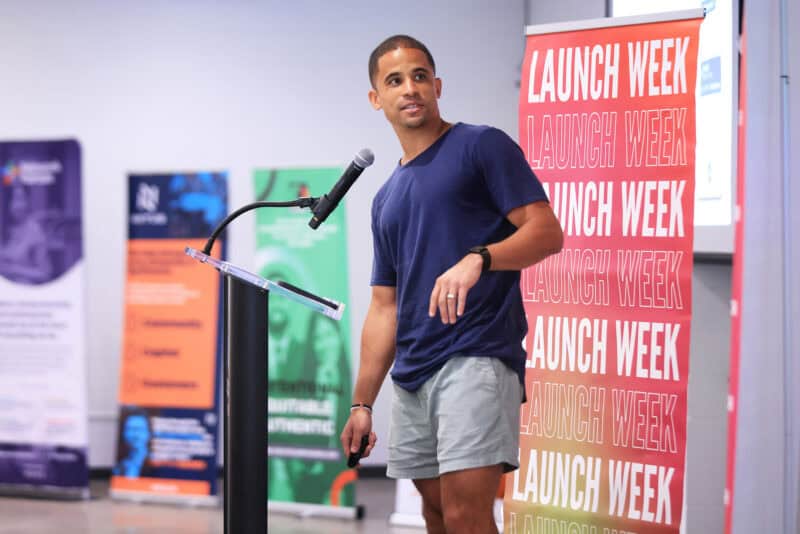
Grayson Smith, founder and CEO, Intuidy; photo by Austin Barnes, Startland News
Editor’s Note: Intuidy is a paid partner of Startland News.
Miles Finch had plenty of data, yet he was still lacking a clear picture of his business.
Running his insurance agency meant hunting information scattered across commission software, financial records, marketing reports and other systems. Answering questions about employee performance or growth could mean pulling statements, gathering documents, writing figures on a whiteboard, moving them to a notepad and ultimately building out an Excel spreadsheet.
And even then, Finch wasn’t always sure he was looking at the right numbers.
“I want to scale,” Finch said. “I want to be more than just a mom-and-pop insurance agency and really want to blow this up. What does that take?”
It’s a problem Grayson Smith believes businesses increasingly share: The information needed to make better decisions frequently already exists. The harder job is collecting it, understanding what it means, separating meaningful signals from noise and putting those insights to work.
 The Lenexa-based CEO of Intuidy isn’t betting his company’s future on building a smarter artificial intelligence model. OpenAI, Anthropic, Google and others are already fighting that battle.
Smith instead wants Intuidy to build the architecture around those models — allowing businesses to connect their own information, define what it means and what AI is allowed to do with it, then use increasingly capable coding agents to build software around the way those businesses actually operate.
Intuidy calls that architecture AIPI, short for Artificial Intelligence Programming Interface.
And if Smith’s bet pays off, business owners like Finch won’t need to understand much of what is happening below the surface.
Not another AI model
AIPI wasn’t Intuidy’s original destination.
The company previously built Vantage, an AI enablement platform designed to connect intelligence with existing business operations. But customers increasingly wanted Intuidy’s capabilities without another dashboard to learn.
A request from an investment firm helped bring that tension into focus.
The client wanted software that could evaluate potential deals against its existing portfolio, score them according to predetermined criteria and explain why a deal did or didn’t meet its standards.
Intuidy could build those capabilities inside Vantage. Then Smith’s team could look at the interface the client would have to learn and go from there.
Instead, he experimented with building a custom front end connected to Intuidy’s existing infrastructure. That trial produced a larger realization: The company could use the same underlying technology not only to connect AI with other software, but to power databases, authentication, security, workflows and other backend functions for entirely custom applications.
Smith increasingly saw the opportunity not as another interface, but as infrastructure.
Today’s AI coding agents can already generate significant amounts of software from natural-language instructions. But independent research suggests going from generated code to a complete, reliable application remains considerably harder.
A recent arXiv preprint from researchers at Vals AI and MIT tested 16 frontier models on 100 end-to-end application-building tasks involving real-world requirements including databases, authentication, email and payments. In the researchers’ latest results, the strongest model successfully completed 58 percent of held-out workflows, with performance generally declining as applications became more complex and required outside integrations.
The researchers frame the changing challenge succinctly:
“The question is no longer whether AI can write code, but whether it can build software.”
Smith believes that’s where Intuidy fits, he said.

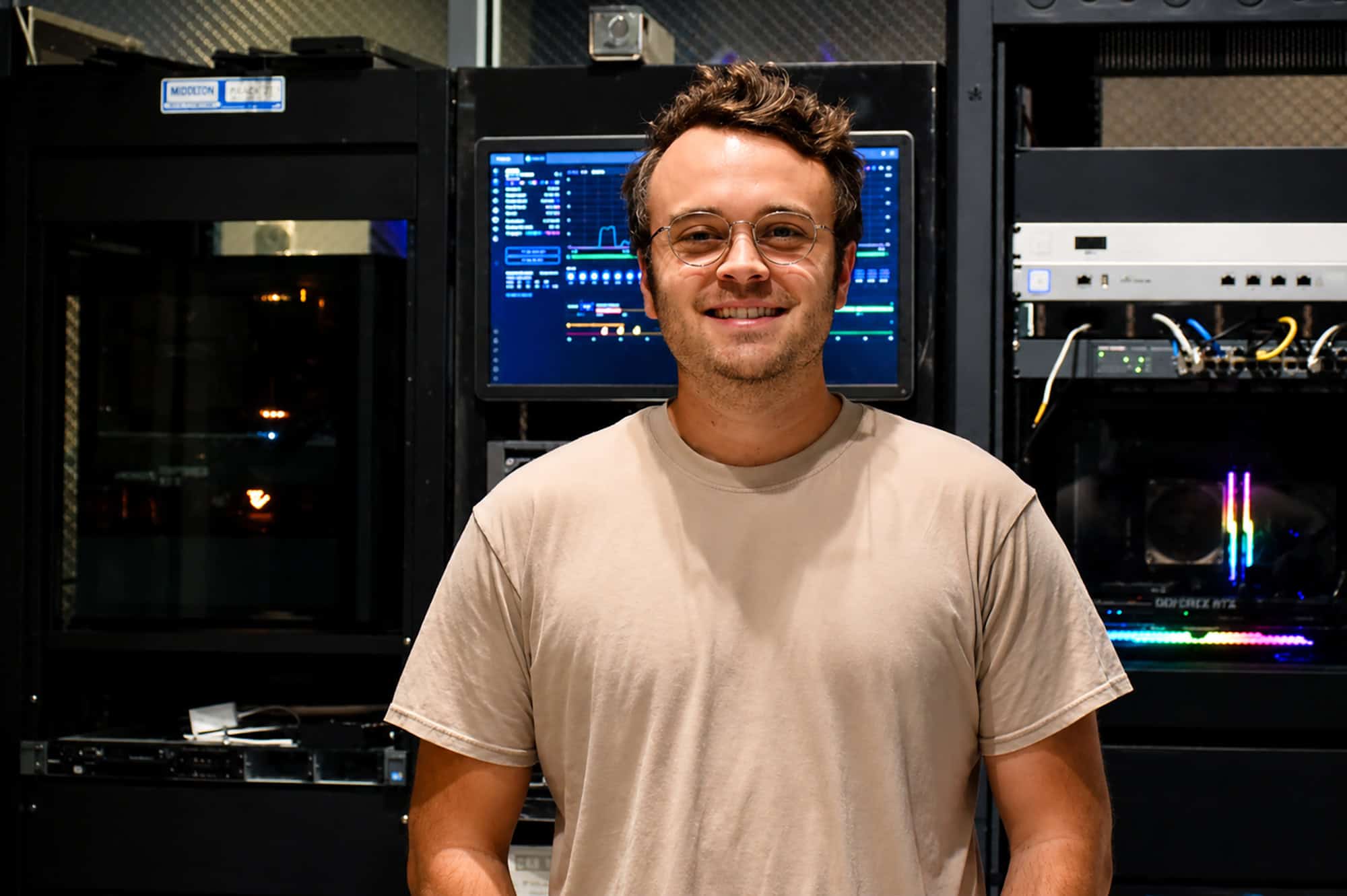
Grayson Smith, founder and CEO, and David Lickimbat, chief operating officer, Intuidy; photo by Austin Barnes, Startland News
Before AI can find the answer, it has to understand the question
Connecting a company’s information to AI creates another problem.
A database might contain the number an AI needs. That doesn’t mean the AI understands what the number represents.
Intuidy’s answer is something Smith calls an ontology.
“An ontology is a dictionary of the business that the AI is required to use,” he said.
A cryptically labeled database table, for example, can be defined as customer transactions. Terms such as “active customer,” “booked revenue” or “churn” can be defined according to what they mean inside a particular company rather than whatever meaning an AI model might infer.
That distinction matters because two businesses can use the same word to mean subtly different things — and an AI system capable of producing a convincing answer isn’t necessarily producing the right one.
Smith said Intuidy’s ontology compares what connected systems contain with what the company has told Intuidy those things mean. It also tracks when sources were refreshed, flags definitions that have become outdated and identifies data that hasn’t been defined.
Undefined information, Smith said, isn’t quietly interpreted by AI. It’s excluded.
That doesn’t solve another fundamental problem: bad information.
Finch, for example, manually enters some of the financial and operational information used by his system.
Intuidy can then record who or what supplied a number, when it entered the system and whether anything has refreshed it since, Smith said.
It cannot determine whether Finch typed the right number, Smith added.
“What we won’t do is quietly fill a gap with something plausible,” he said. “The job is to make weak inputs visible instead of invisible.”
For Finch, the payoff isn’t understanding the architecture. It’s being able to ask better questions of the business.
Knowing what data means doesn’t grant permission to use it
Finch is clear about another boundary: Identifying customer information isn’t being fed into the system he’s developing.
But his application can still involve sensitive business information — employee performance, compensation, revenue and marketing spending among it.

Grayson Smith, founder and CEO, Intuidy; photo by Austin Barnes, Startland News
That raises a different question: If AI can increasingly interact with a company’s data and software, what prevents an agent from seeing something it shouldn’t — or taking an action it isn’t authorized to take?
Intuidy separates access from governance, Smith said.
Credentials determine which systems an application or agent can connect to and whether it has read or write access. A separate governance engine determines what information can actually move once that connection exists.
“Permission to reach data has never been the same thing as permission to move it,” Smith said.
Customers can establish rules that redact sensitive information, require human approval or block an operation entirely, he added, noting those rules are enforced outside the AI model itself, meaning Intuidy isn’t simply instructing an AI through a prompt to follow company policy.
“Data that Miles has ruled off-limits isn’t something the AI politely declines to use — it never reaches the AI at all,” Smith said, referencing Finch’s business’ interaction with the technology.
Customers can also make agents read-only, require approval before particular actions and review records of what an agent accessed, attempted and completed, he said.
Intuidy uses encryption in transit and at rest, tenant isolation, least-privilege access and audit logging, Smith said, adding that the company is currently undergoing a SOC 2 audit.
For all that automation, however, he draws an important line around responsibility.
Intuidy doesn’t decide when a customer’s software is ready for production.
Someone still has to define ‘ready’
The near-instant development Finch describes is possible partly because customers aren’t necessarily beginning with an empty screen, Smith said.
Intuidy offers templates for working business systems that customers can modify, along with what Smith calls agent skills: written procedures AI agents can follow when reviewing applications against a company’s standards.
A customer might use a review skill to examine data access, permissions or application structure, then modify that procedure to account for its own industry, compliance obligations and definition of what constitutes finished software.
That doesn’t mean Intuidy certifies the result.
“The customer authors their own definition of ready, and they own the verification,” Smith said.
That’s a significant distinction as AI coding tools promise to compress software development from months to days — or, in Finch’s experience, sometimes minutes.
The researchers behind the arXiv preprint similarly find that models capable of testing and debugging their own work perform substantially better than models that don’t, underscoring the difference between generating software and establishing that it reliably works.
Smith’s argument isn’t that verification disappears.
It’s that much of the infrastructure and procedure that once required specialized technical knowledge can increasingly be packaged, reused and handed to AI agents.
For Finch, the architecture looks like a coach
Finch freely acknowledges he doesn’t understand everything happening behind the software he’s building with Intuidy. He knows the business questions though.

Miles Finch, State Farm
One of his central goals is better employee coaching.
Instead of spending hours manually calculating performance or relying on a manager’s impression of where someone is struggling, Finch wants the system to combine operational data into a continuously updated view of what is working — and what isn’t.
“The checker gets what the checker checks,” Finch said. “It’s very hard as a small business owner to always check everything.”
That visibility could change the conversation on both sides.
A manager could identify a specific area where an employee needs improvement rather than simply telling that person to hit a KPI. An employee could also see where they’re succeeding instead of waiting for a manager to notice.
Finch describes it simply as a “live coach.”
He’s also experimenting with benchmarking, comparing performance against corporate expectations as well as current results among agencies participating in his system.
Intuidy itself does not supply a generic industry benchmark, Smith said. Instead, customers determine which data and standards should form the comparison — another example of the distinction between AI providing an answer and a business defining the context required to make that answer useful.
Finch is still discovering what he can build.
“I don’t even understand the potential yet,” he said.
But the development process itself has already changed his expectations.
“I can speak an idea and we can brainstorm it, and then it’s actually a functioning feature now — not even tomorrow, within minutes.”
A Kansas City company betting on the layer below AI
Intuidy remains bootstrapped. The company employs about 13 full-time workers, Smith said, and has helped create roughly 40 custom tools using AIPI so far, with customers spanning industries including real estate, healthcare, logistics, oil and gas, public safety and food production.
He expects outside capital eventually could enter the picture as Intuidy’s ambitions extend into hardware and robotics.
For now, though, the company’s wager is fundamentally about information.
AI models are becoming increasingly capable of writing code, analyzing data and taking actions. Smith isn’t trying to build a better brain.
He’s betting businesses need a better way to connect those brains to the information they already possess — while defining what that information means, what AI is allowed to do with it and when a human still gets the final say.
Intuidy is actively looking for Kansas-area businesses ready to build AI into their operations the right way, Smith said — connecting and syncing every system they run, creating trackable KPIs across the business, and giving AI the ability to take action in a way that’s predictable, controllable and grounded in the partner’s own ontology.
“We’re Kansas City proud, and there’s nothing greater than working with like-minded companies in our own backyard,” he said. “This invitation isn’t for everyone. It’s for the Kansas City companies doing important work in their industries — the ones ready to blaze the trail everyone else will follow. If that’s you, we want to hear from you.”
Fund More Stories
This story was made possible by readers like you. Join them — make a one-time contribution or become a monthly member to sustain our work.