Pedaling a dream: Concierge bike shop street tests whether repairs alone can keep business torqued
April 25, 2026 | Joyce Smith
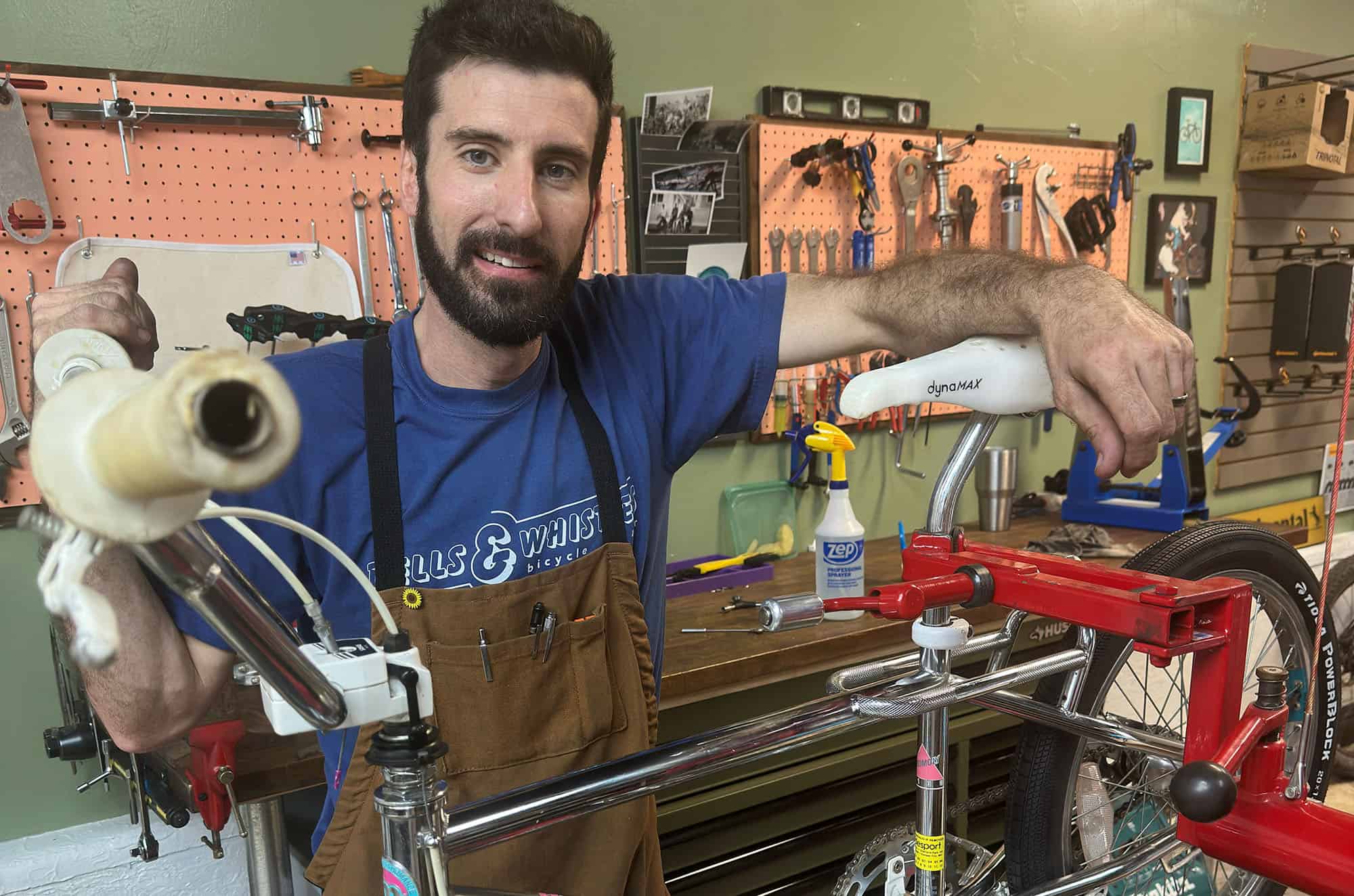
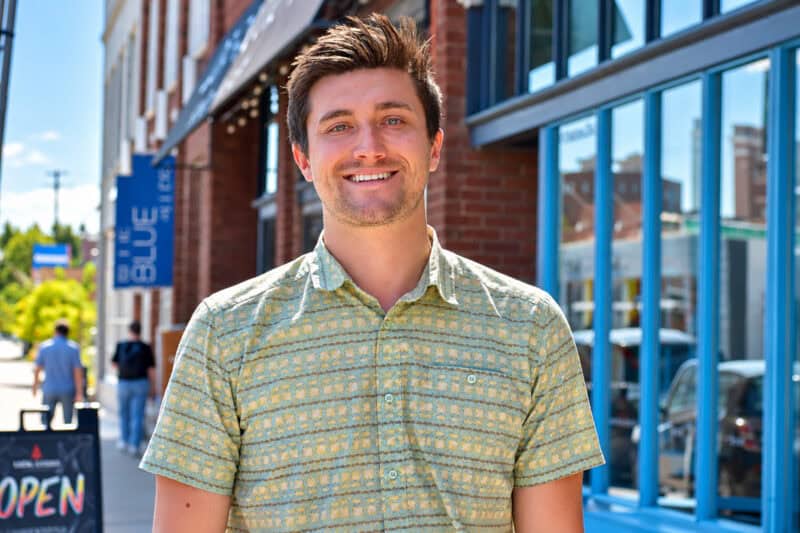
Aaron Apel inside Bells & Whistles Bicycle Repair, 7140 W 80th St, Overland Park; photo by Joyce Smith
Aaron Apel struggles to come up with a fitting description for his new downtown Overland Park shop Bells & Whistles. For now he’s dubbing it a “bicycle concierge service.”
“It sounds snooty, but it is a level of attention I want to offer people,” he said.
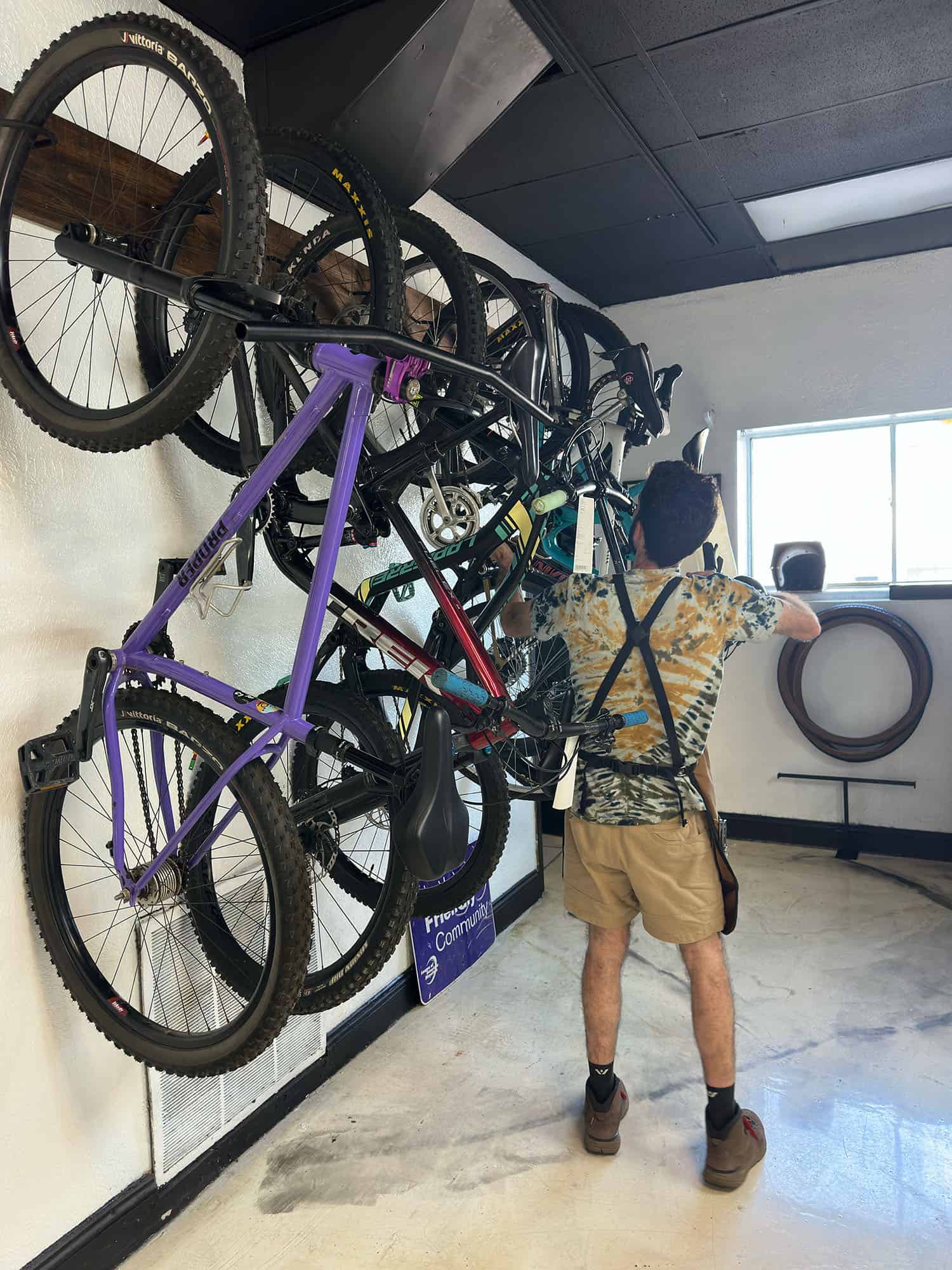
Aaron Apel pulls a bike down from the rack at Bells & Whistles Bicycle Repair, 7140 W 80th St, Overland Park; photo by Joyce Smith
The shop isn’t officially open yet. The windows are papered over, waiting to be replaced by his landlord, and the air conditioning conked out right when temperatures soared into the 80s. (A grand opening will probably be delayed until mid-to-late May, Apel said.)
Still, customers are finding him.
One nearby resident brought in a bright red 1980s cruiser that had been parked in her garage for years.
“It’s not had a lot of TLC in awhile,” said Apel as he scanned the bike, chest-high on a repair stand. “New tires and lube so it’s safe to ride.”
On a recent weekday morning, the door was wide open for repairmen and curious folks wondering what’s behind the papered over windows. Apel pulled down a more modern mountain bike that needs work on its suspension and electronic shifting.
But the apron-clad entrepreneur is also out to answer a longtime question: Can he make a living just on bike repairs?
“They say you can’t raise a family, you can’t buy a house on a mechanic’s salary,” Apel said. “It’s just one of those industries where we haven’t been able to professionalize the mechanic side of things.”
Cycling through entrepreneurial experience
While growing up in Topeka, Kansas, Apel mowed lawns to pay for his first bicycle: a Trek Multi-Track 830 in a faded-green-to-blue color.
“I loved that bike,” he said. “If I could find a bigger version today, I would probably buy it and refurbish it. Just because.”
His father, Alan Apel, is a lifelong cyclist, and Aaron soon joined him on the MS 150 — a legendary two-day ride that serves as the largest fundraising event for the National Multiple Sclerosis Society.
The Apels put slimmer tires on Aaron’s mountain bike, and Alan taught his son how to change a tire, lube the chain and other basic maintenance that would take them through the 150-mile ride from Topeka to Emporia and back.
“We had to train all summer. But I also was very energetic, always on the move,” he said.
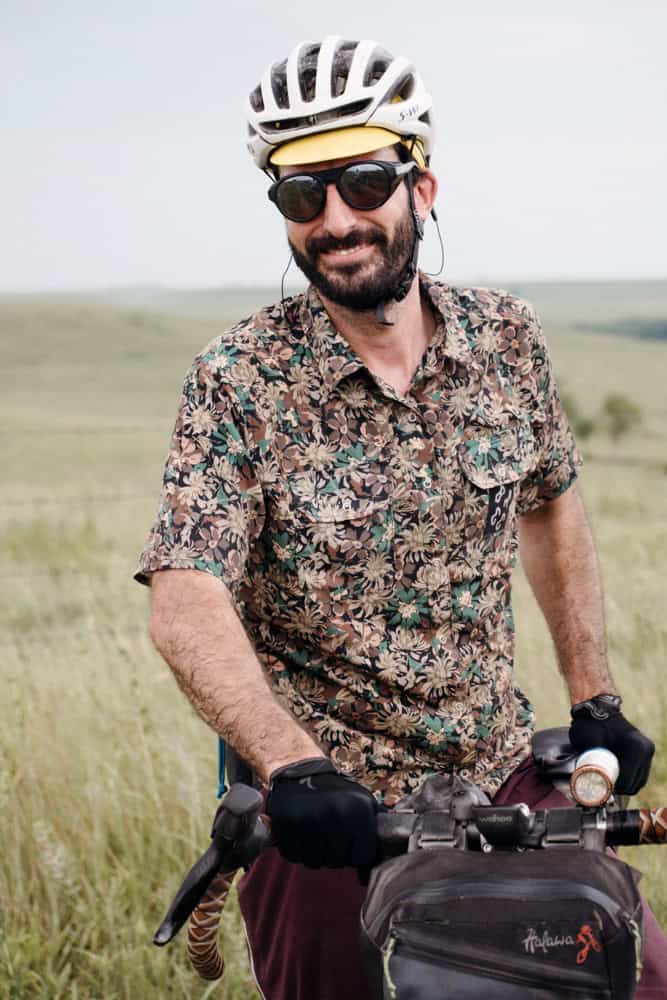
Aaron Apel behind the handlebars; courtesy photo
Apel earned degrees in political science and philosophy with a minor in leadership studies from Kansas State University in 2008-2009. During that time, he worked as a bike mechanic at Manhattan mainstay The Pathfinder, a bike and camping shop.
The Pathfinder offered to send him to SRAM Technical University to earn a certificate in the areas of suspension, drivetrain components and brake systems.
“I quickly developed a fascination on how bicycles worked,” he said. “I could process information and have more clarity when I moved and worked with my hands. I found a different way to learn.”
That training also fired off a two-decade pursuit of the best training available. Just a few of the many certificates Apel has earned now hang on a wall by the front window.
“I liked seeing people getting out and being active,” he said. “Any person can be a better version of themselves if they go pedal a bike once in a while.”
Before graduating, he left Pathfinder to start Big Poppi Bicycle Co. with Jeff Koenig.
“I was a poor college student who knew bikes so I needed someone who knew business,” Apel said. “Jeff was my business mentor. He had started and operated a number of businesses by that point in his life. He looked for people who had a particular skill or interest to partner with in a new business.”
Apel likened the experience to earning an undergraduate degree in bike shops: bookkeeping, inventory management, marketing, even exit strategy.
The full-service shop was almost immediately profitable and allowed Apel and his wife, Melanie, to pay off their student loans. Melanie handled much of the administrative side.
Instead of resenting the competition, his former manager at the Pathfinder, Dave Colburn, remained a mentor and is still Manhattan’s bicycle guru, Apel said.
“We supported and encouraged each other and played to our strengths,” Apel said.
For Big Poppi, that meant leaning into community events and projects.
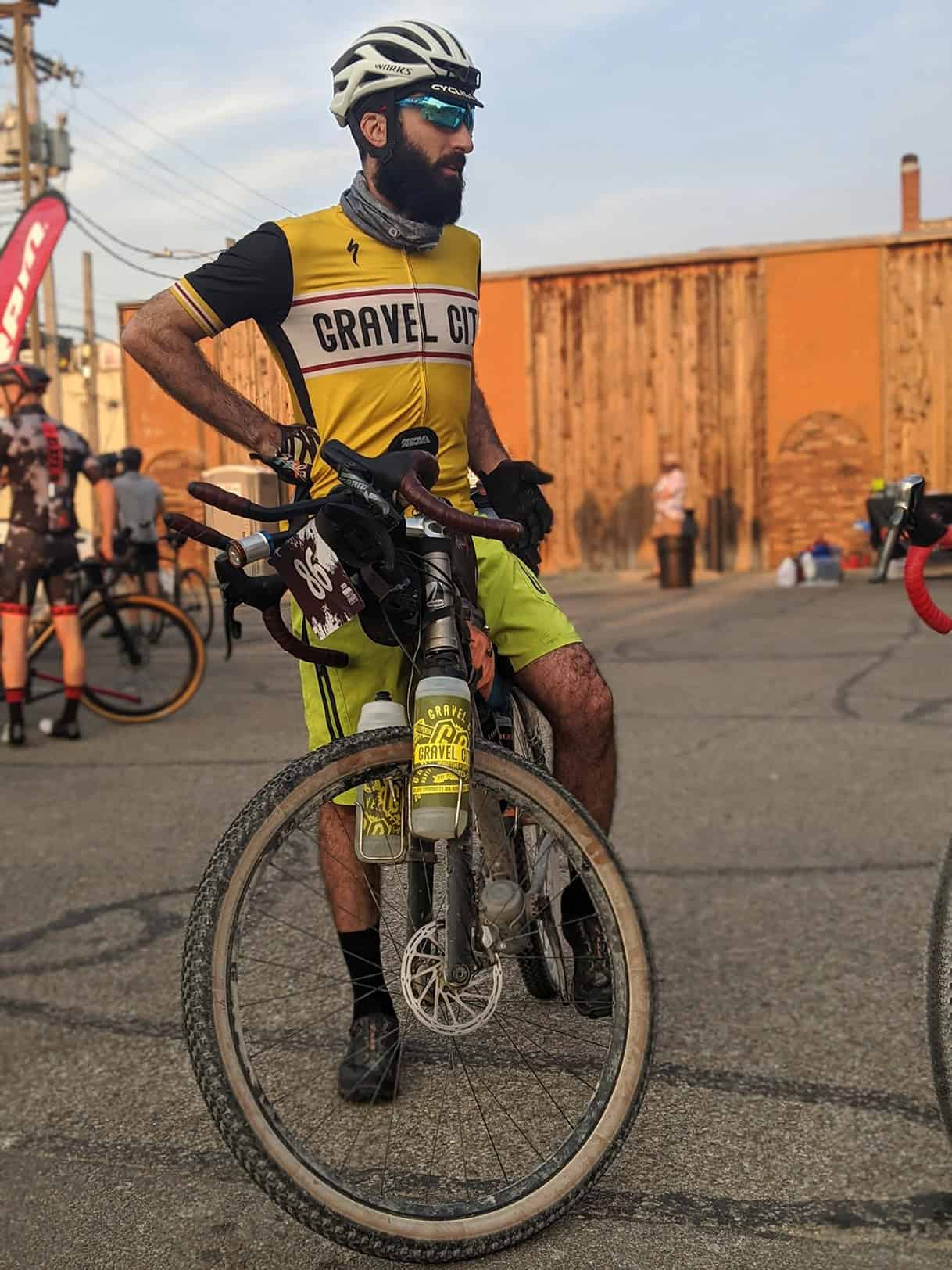
Aaron Apel rests on his bike in 2020 amid a multi-day ride through the Flint Hills in Kansas; courtesy photo
Apel hosted rides, served as president of the Aggieville Business Association, was a fundraiser and organizer for the Little Apple New Year’s Eve celebration for a couple of years (an event that can draw up to 10,000 people) and helped to build a mountain bike trail.
“That’s where the burnout comes in. I said yes to too many things,” he said.
By late 2015, the partners were ready to sell the award-winning shop, but most of the people interested in buying it were cashing in their 401(k)s and looking for an investment.
“They would have been absentee owners,” Apel said. “That would not have been the best for the business, best for the community or best for the people buying it.”
After closing the shop, Apel worked for a friend’s Manhattan marketing agency (which had previously done work for Big Poppi), had a short stint building professional mountain bike trails in Arkansas, and then worked as head of marketing and business strategy for a Manhattan architecture firm.
Then earned his “masters degree” in the bike industry through the former Gravel City Adventure & Supply Co. in Emporia (now Merchants Cycles).
After nearly four years, the Apels moved to the Kansas City metro so Aaron could work at Pleasant Valley’s Chamois Butt’r, which manufactures a non-greasy, anti-chafe skin lubricant designed for cyclists. His friend and mentor there taught him the ins-and-outs of production and wholesale business.
Then he spent more than a couple of years at another friend’s Cycle City in the River Market. He left when the shop closed.
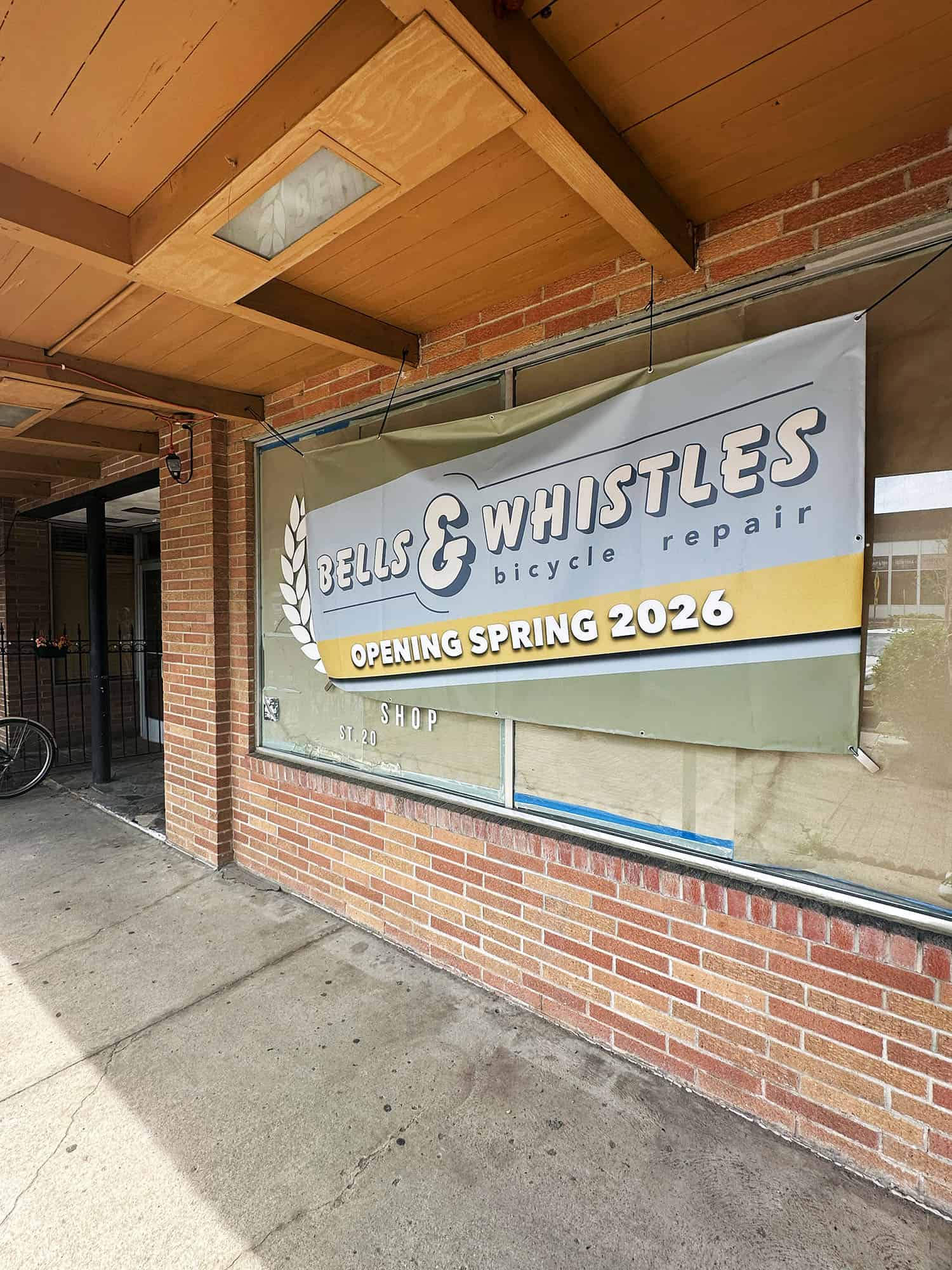
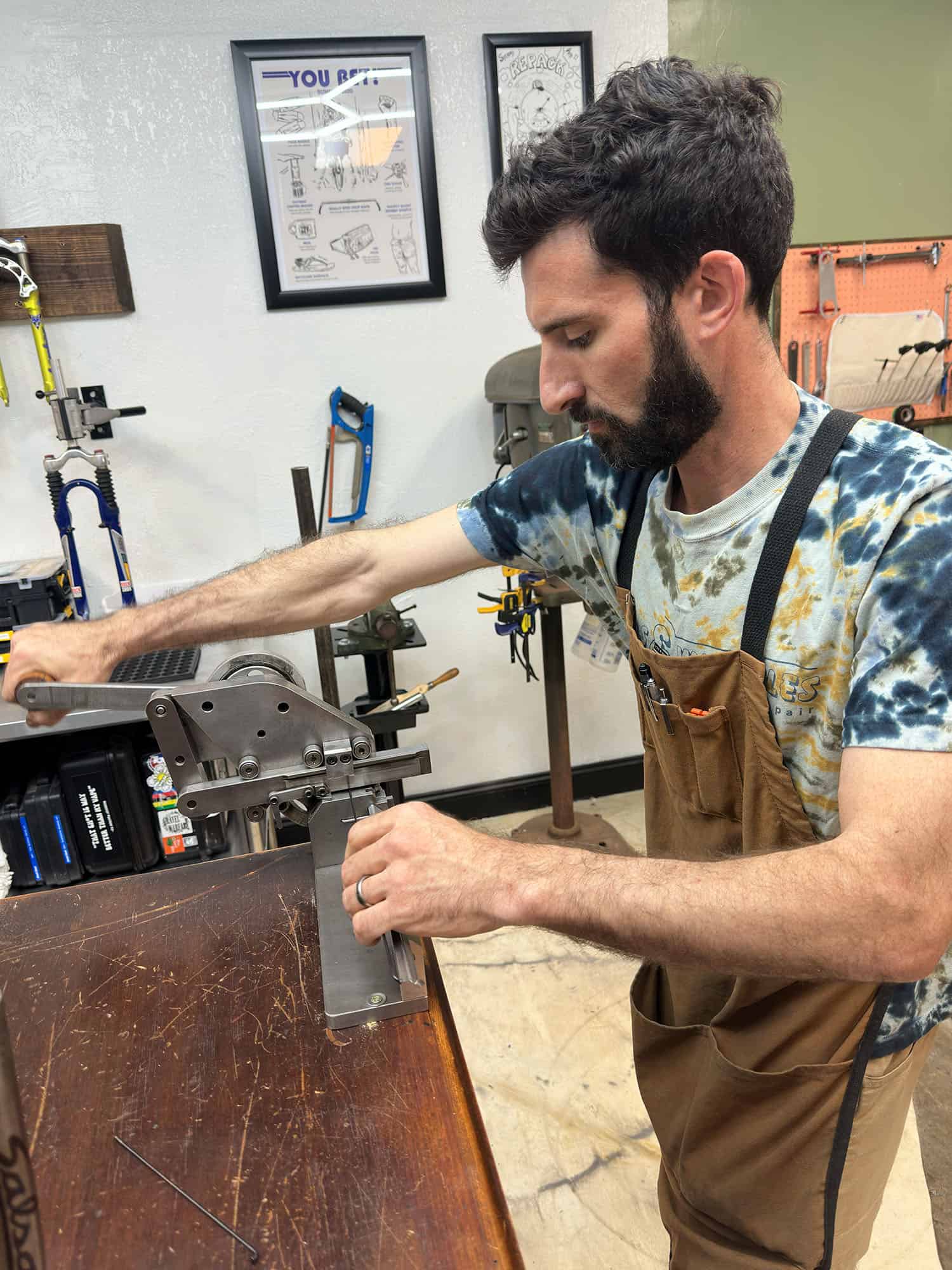
Skid stop in downtown OP
That brings him to Bells & Whistles.
Do the experts think his business model can work?
“A couple of years ago, I would have said no. Today I would say yes, if he does it right,” said Jay Townley, a founding partner of Human Powered Solutions (HPS), and a consultant with the National Bicycle Dealers Association (NBDA). Townley has been in the industry since 1957 when he was a 13-year-old working at his neighborhood bike shop.
COVID created a surge of consumer interest in bikes as people sought activities they could do outside, he said, but noted sales did not keep up with true consumer demand.
“There’s even talk now that there is too much inventory. So they cut prices to move inventory to pay debt,” Townley said. “The industry now is chaotic, confused. We are an import-dependent industry, primarily from Asia. Tariffs have added 25% or more increases in prices for bikes and parts.”
Several Kansas City area shops have closed in the past couple of years, including Cycle City in the River Market, although it still has a Parkville shop.
But Townley said there is a growing consumer interest in used bikes, which also offer shops a better profit — as much as 50% gross margin.
Wisconsin-based Townley knows of bike repair shops in his state that are successful.
“Madison is a biking town and if a mechanic is excellent, reliable and has connections to get the parts, then they can make a profit as a service center,” he said.
He not only recommends adding used bike sales to Bells & Whistles’ lineup, he said Apel should join the NBDA and check out its Youtube videos and webinars on selling used bikes and tips for profitable service operations.
Bike sales are the biggest chunk of a shop’s revenue, with bike repair often a loss leader. But Townley and the NBDA are looking to have service techs recognized as a profession and the workers paid a fair labor price.
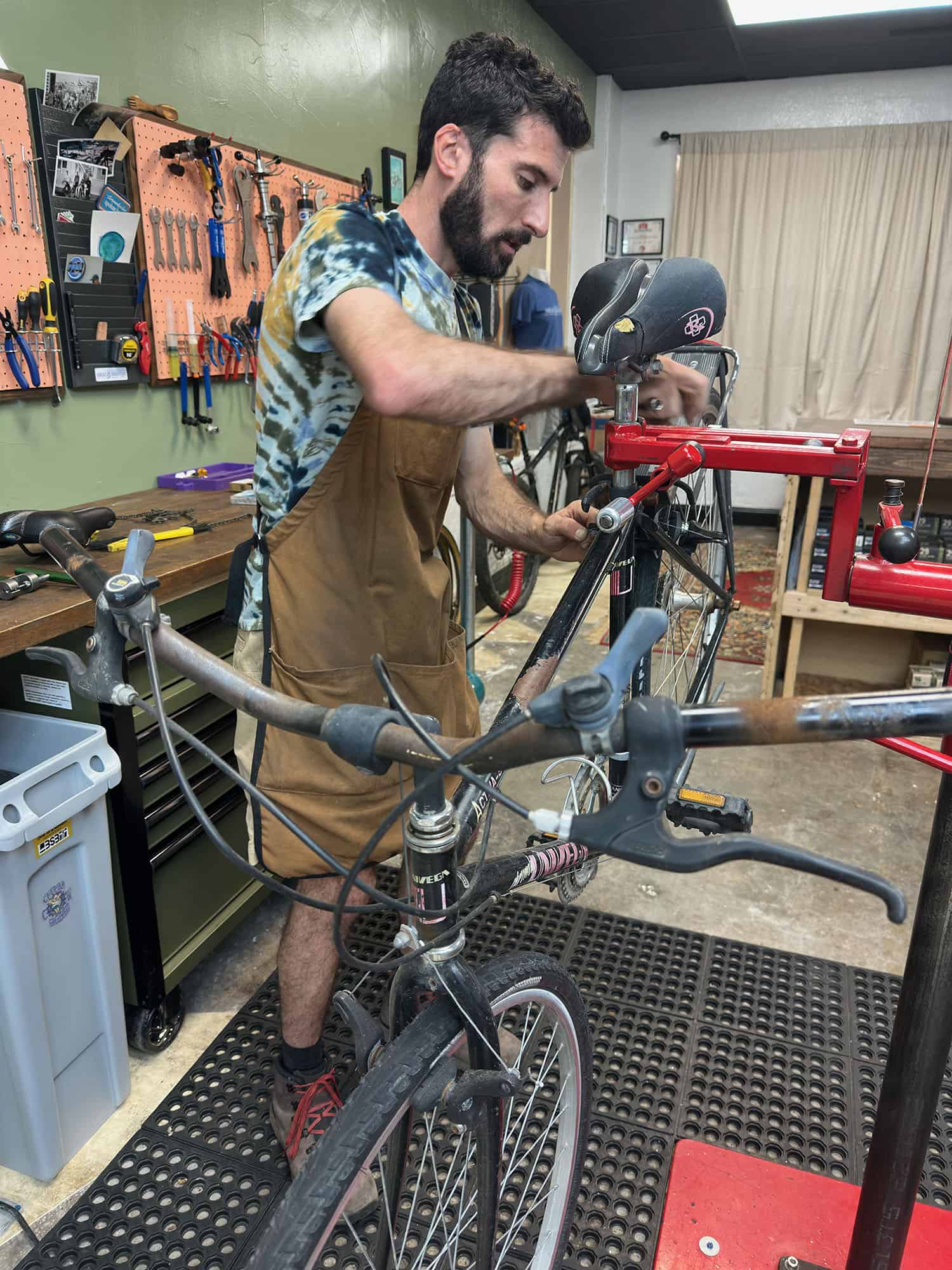
Aaron Apel works on a bicycle repair at Bells & Whistles in Overland Park; photo by Joyce Smith
According to a May article in trade publication Bicycle Retailer and Industry News, the U.S. Department of Labor had just recognized bicycle repair as apprenticeable. The trade publication said apprenticeable occupations generally are learned through a program of on-the-job supervised training combined with instruction to meet industry standards, much like apprenticeship programs for plumbers and pharmacy technicians.
For now Apel is not only focused on repair, he plans to expand by building custom bikes to “fit like a glove.”
He’ll also replace some parts on a customer’s current bike to improve the fit, and will help advise people searching for a good used bike. He may even sell a used bike and two along the way.
The shop is expected to hold monthly bikepackings (ride and camp events) as well as morning coffee rides. In the fall and winter he’ll focus on education classes.
“Here you will know who is working on your bike every time and are committed to understanding how your bike works,” Apel said. “When they walk in the door, I want a new friend and the best way I can be a friend to them is to make sure their bike is working the best way it can when they walk out the door.”
Startland News contributor Joyce Smith covered local restaurants and retail for nearly 40 years with The Kansas City Star. Click here to follow her on Bluesky, here for X (formerly Twitter), here for Facebook, here for Instagram, and by following #joyceinkc on Threads.
7140, West 80th Street, Overland Park, Johnson County, Kansas, 66204, United States
Fund More Stories
This story was made possible by readers like you. Join them — make a one-time contribution or become a monthly member to sustain our work.