Network Kansas exec passing CEO torch to decades-long collaborator who co-built the entrepreneur resource community
October 1, 2026 | Tommy Felts
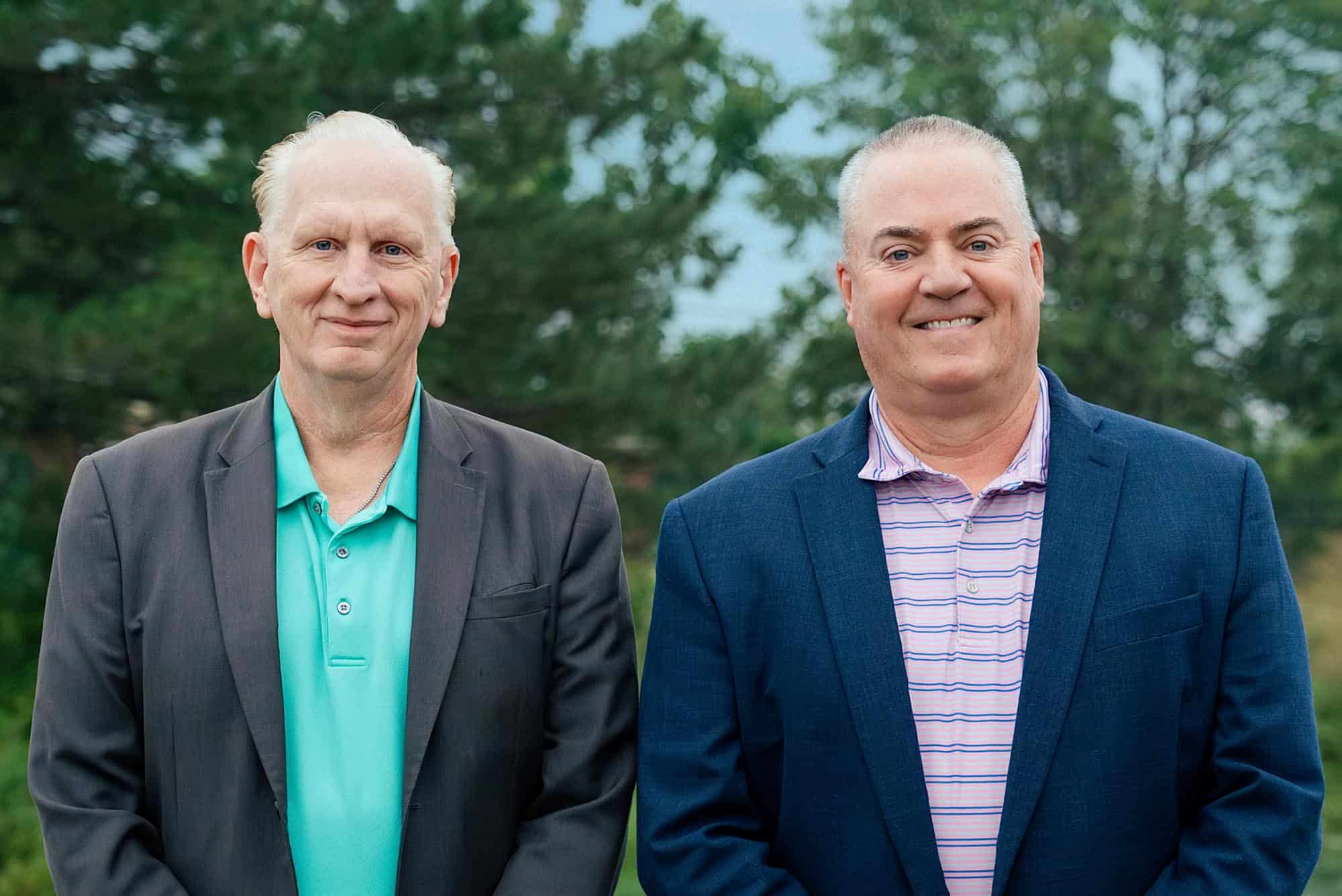
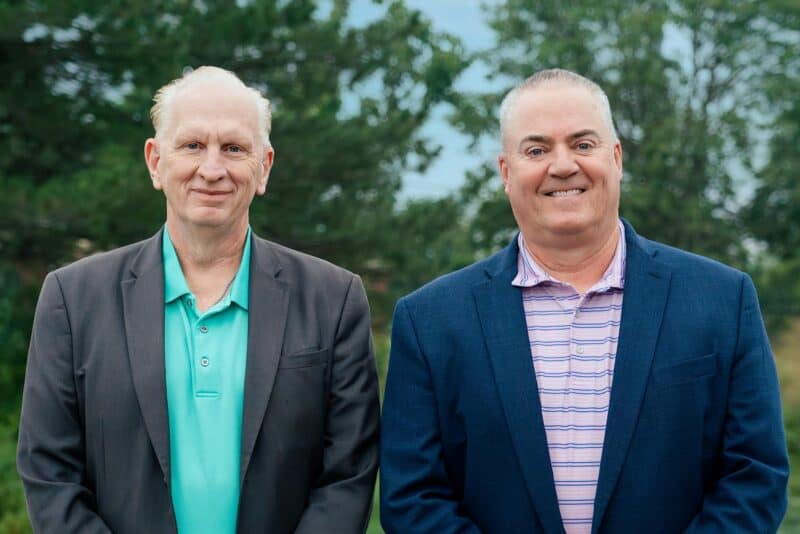
Steve Radley and Erik Pedersen, the outgoing and incoming CEOs for Network Kansas; photo courtesy of Network Kansas
With the duo starting their jobs at Network Kansas just two weeks apart, Erik Pedersen feels like a co-founder, said Steve Radley. Now, 21 years later, the organization’s first employee is preparing to depart, leaving his longtime friend and colleague to step into the top role.
Network Kansas on Thursday announced an executive leadership succession plan that will see Pedersen, current president and COO, transition to CEO of the statewide hub of non-profit business-building resources when Radley steps away from the position in April 2027.

Erik Pedersen, Network Kansas
“The value system of empowering partners and eCommunities is steeped in his value system,” Radley said of Pedersen. “There will be no quarter given to any strategy or initiative that deviates from that value system.”
Both men joined the entrepreneur support organization in 2005 — just after it was established (as the Kansas Center for Entrepreneurship) by statute through the Kansas Economic Growth Act of 2004. The goal: to connect Kansas entrepreneurs with essential financial resources, valuable relationships, expert knowledge, and experience through a statewide network of partners and eCommunities.
“It has been an honor to work with partners, communities, five gubernatorial administrations, and the Kansas Legislature to build the most vibrant and connected entrepreneurial ecosystem in the country,” said Radley. “The timing is perfect for this transition with the change in administration in the forefront coupled with the strongest executive and senior leadership team we’ve had in our history.”
Thursday’s announcement comes after several years of intentional succession planning by executive leadership, the Network Kansas senior leadership team, and the board of directors, the organization said.
Community leaders and longtime partners from across the state lauded Radley’s leadership and steady hand.
“During his tenure, Network Kansas grew to become not just a source of resources and partnership, but critical infrastructure for our community,” said Melissa Roberts Chapman, president of KC BioHub and a longtime collaborator through numerous Kansas-focused entrepreneur support organizations. “Perhaps most impressively, Steve has developed an incredible bench of leaders — including both those who will be leading the organization forward, and those who have moved on to other roles in our community. Steve’s legacy extends far beyond the walls of just one organization, and I am grateful for his many years of service to our entrepreneurial community.”
The incoming CEO agreed that Radley’s approach to community building put the organization they co-built in a position to catalyze entrepreneurs like few others across the country.
“Steve is a true visionary and is the reason you will find nothing similar to Network Kansas in other states,” Pedersen said. “This model required the state-level leadership to forego ego and give power, as well as financial resources, to people they didn’t even know.”
“As long as I continue to believe in this vision and follow our mission statement,” he continued. “I believe Network Kansas has an exciting future as we continue to help and support Kansas small businesses and entrepreneurs.”
It’s their community, not ours
Radley expressed pride that after building strong relationships with more than 650 partners and eCommunities, it became apparent that Network Kansas could live in perpetuity and create long lasting resources for Kansas entrepreneurs, he said.
Much of that success he credits to the creation of the network’s eCommunities themselves — more than 80 groups across the state (grown from just six) that have local leadership teams and financial review boards to drive strategies that connect entrepreneurs to resources and make decisions on Network Kansas companion loans in their communities.
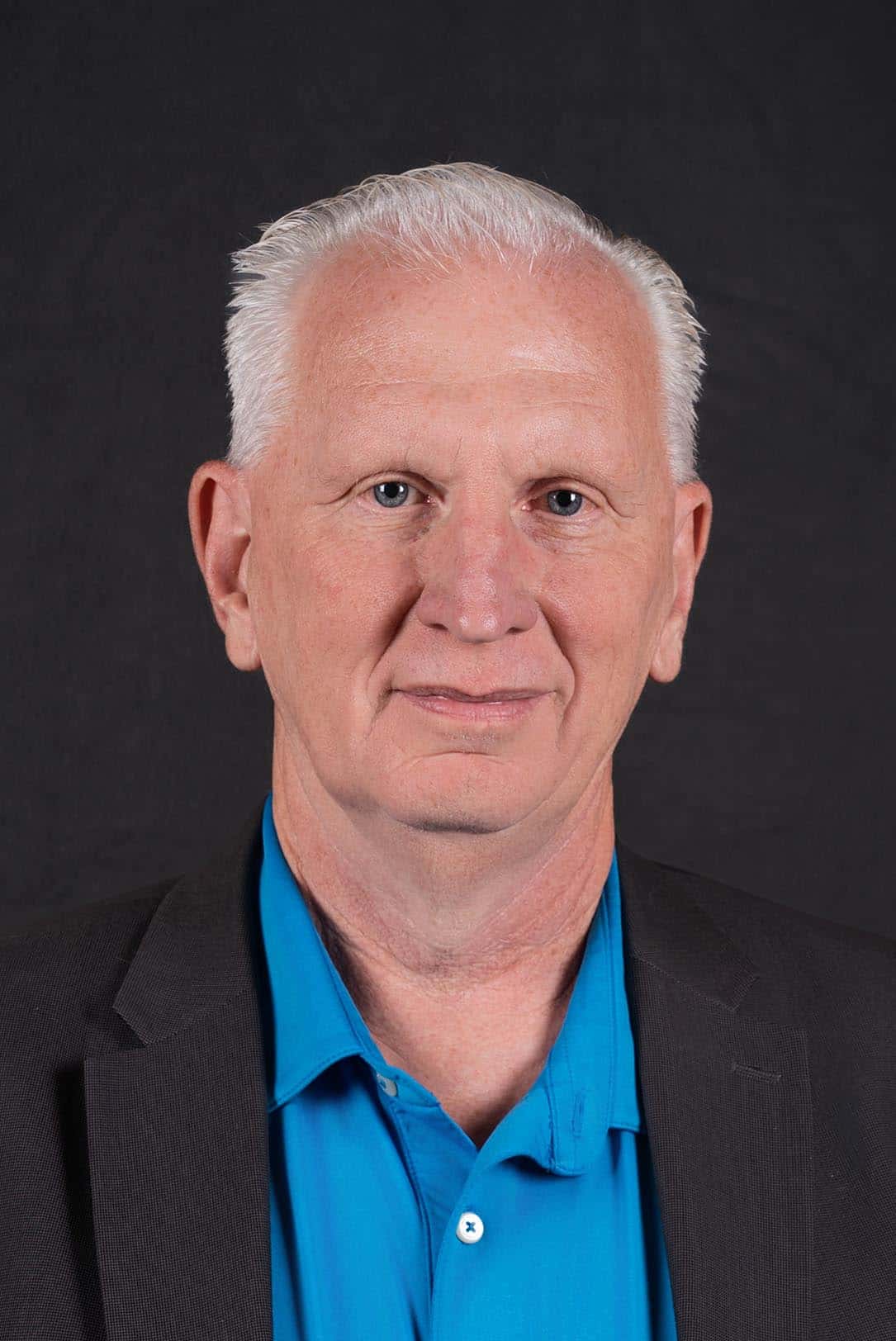
Steve Radley, Network Kansas
“I’ve been on hundreds of national calls and I always ask people, ‘How do you empower communities?’” Radley said, noting he often is baiting his peers with the question. “The answer is decision making. And nobody does it. Even the most mission-oriented organizations ‘export’ decision making.”
“I like to tell national organizations that we ‘import’ decision making to local communities and we do,” he continued. “In the end, we should succeed or fail with the communities because it is their community, not ours.”
Working in tandem with such local eCommunities leaders is at the core of Network Kansas’ strategy, Pedersen added, because they’re the ones who truly know what challenges are being faced and what tools — be it programming, gap financing, or simply a connection — could be most effective.
“Network Kansas has always believed that the solutions to a community’s challenges can and should be solved in the community, where the residents are the experts,” he said.
Radley also noted critical Network Kansas proof points came when the Kansas Department of Commerce asked the organization to be the lead administrator for the State Small Business Credit Initiative (SSBCI) in 2009, as well as its high-profile follow-up in 2021.
“That also taught me the most important fact about entrepreneurship: ‘execution’ is the most critical element that causes a business or organization to succeed or fail,” Radley said, noting Network Kansas’ SSBCI work uncovered several other realizations.
Among them, he said: the partner and eCommunity networks are the most scalable networks in the state of Kansas and most other states don’t have them; Kansas is flush with talent at the local, regional, and state level (they combine this with unparalleled passion for where they live); and Kansas is an exemplary standard (as seen by the U.S. Treasury Department) for distributing entrepreneurial resources to all geographies.
Still, Radley acknowledged, challenges remain.
“I was telling some of our staff just the other day that it has never been easier to start a business with the number of resources available now versus when we first started. It has also never been tougher to start and grow a profitable business for the long term,” he said.
“The competition has never been greater because, in many cases, it is not geographically fixed,” Radley continued. “Additionally, entrepreneurs must understand the profit imperative: you have to be able to make money to pay yourself, pay your staff, and contribute to the local, regional, and state economy. This is not a Kansas entrepreneurship challenge, this is a global entrepreneurship challenge.”
At the same time, the resources required to be a successful entrepreneur remain unchanged in 21 years, he said, calling out the critical need for financial resources, valuable relationships, expert knowledge, and experience.
“We wrote our first mission statement 45 days after we started in May of 2005 and it has not changed,” Radley said. “That is the science of entrepreneurship. But who succeeds infuses intangibles about the individual entrepreneur, their circumstances, the environment, and on and on. That is the art of entrepreneurship. Both are in play for all entrepreneurs.”
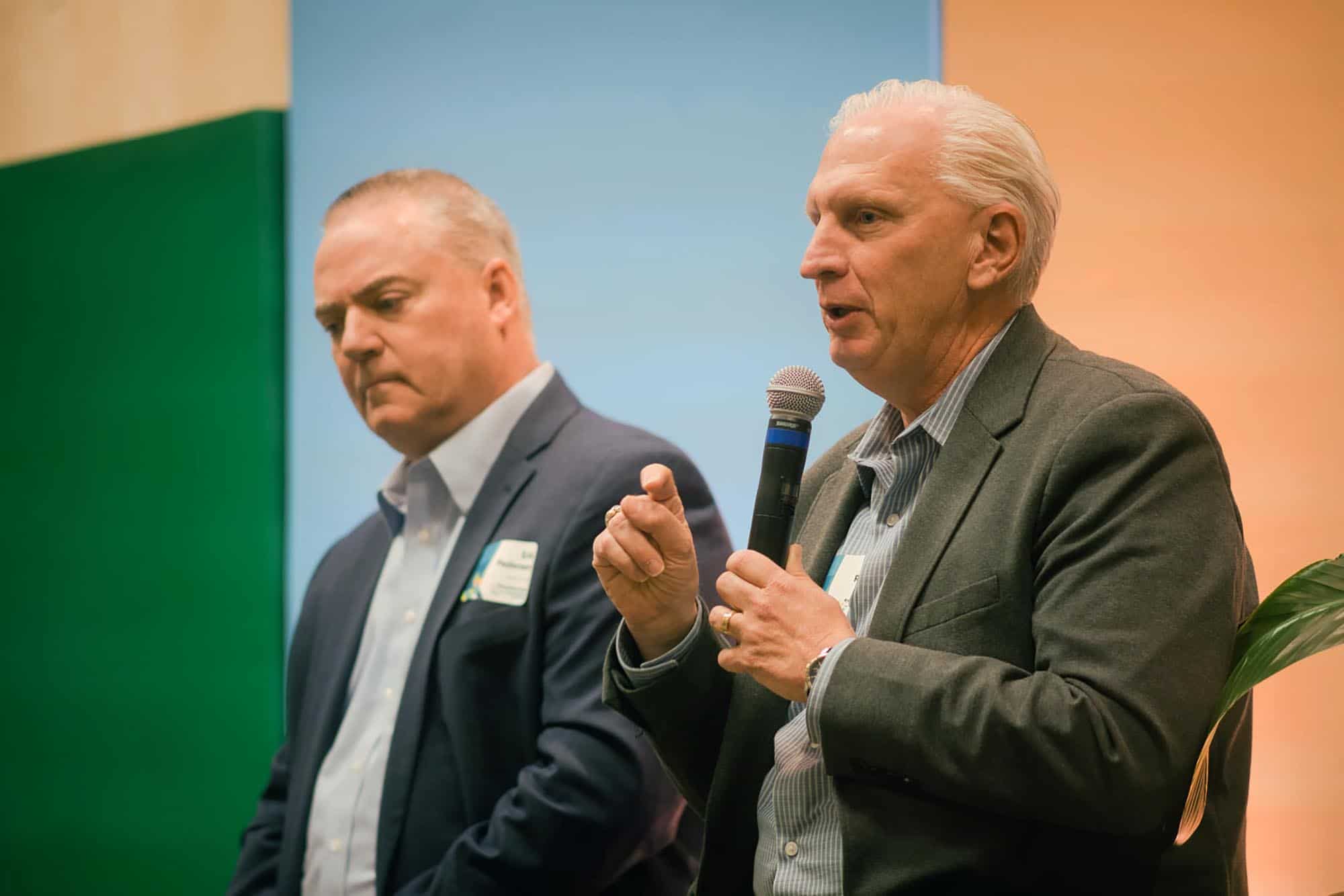
Steve Radley, CEO of Network Kansas, right, speaks on stage alongside Erik Pedersen, the organization’s president and COO; photo courtesy of Network Kansas
Do the right thing
Radley and Pedersen’s work together began long before their time at Network Kansas.
“He and I have a work history that spans almost four decades, and through that time, he’s never wavered in his commitment to do the right thing,” Pedersen said of Radley, calling his front row seat alongside the outgoing CEO an honor.
The duo first teamed up as part-time employees at a Sears department store while they finished their education, later taking jobs at Brite Voice Systems in Wichita. In April 1997 — 30 years before the Network Kansas transition’s CEO handoff is set to be official — they co-founded a manufactured housing dealership, which eventually sold to Champion Enterprises.
When Radley was hired in 2005 to open the Kansas Center for Entrepreneurship (now Network Kansas), Pedersen wasn’t far behind — joining just two weeks later.
Some lessons gleaned from his longtime friend came through direct conversations, Pedersen said; others from observing how Radley grew and guided the organization.
His throughline: the longtime leader’s adherence to his values and integrity.
“That sounds simple,” Pedersen said. “But I’ve seen many instances when it was unpopular, but in the end, others that disagreed with him realized it was right. He constantly reminds me to ensure the steps we are taking at Network Kansas are pointing toward our North Star, our mission statement — offering essential financial resources, valuable relationships, expert knowledge, and experience through our partner networks to empower entrepreneurs.”
Radley and Pedersen both have been guided by a conviction instilled in them by Radley’s father, who previously was the duo’s business partner, Pedersen said: Meet issues head on.
“Don’t avoid an uncomfortable situation, but instead lean into it and work to find common ground with the other party,” he explained. “That was told to us many years ago, and to this day, we still bring it up often.”
What comes next
With six months until the leadership change fully unfolds, Radley said his focus is on ensuring a successful transition. After that, he’ll turn his attention to putting his experience and relationships to use in a new way.
“I just want to thank every partner, every community, every individual that I’ve worked with over the past 21 years,” he said. “I’ve always encouraged our staff to meet with people without an agenda to develop relationships. It is a lot more fun and gratifying working with friends rather than acquaintances. That is what Erik and I have done. I am proud to call all of you not only colleagues but friends.”
Radley offered praise for a number of colleagues and partners who — alongside Pedersen — made today’s Network Kansas possible, including:
My longtime mentor Dr. Donald Hackett, former Director of the Wichita Center for Entrepreneurship who told me about the position opening. Dr. Hackett continues to mentor me to this day.
There are so many people during my time, it’s difficult to name just a few but the people that come to mind include former Kansas Small Business Director Wally Kearns and Deputy Secretary Patty Clark (also former USDA State Director) who got Erik and I started in the right way in the early years. Coming from the private sector, Erik and I had to learn how to pace the build out. In addition, the authors of the Kansas Economic Growth Act that created the Kansas Center for Entrepreneurship (Network Kansas), former State Rep. Kenny Wilk and former State Sen. Nick Jordan who continued to provide guidance and advice throughout the years.
It’s also hard to discuss champions without mentioning one of my favorite organizations we have worked with since the beginning: the Western Kansas Rural Economic Development Association, a group of 55 county economic development directors in western Kansas. They gave Erik and I tough love in our first year and really immersed us both in the opportunities and challenges of rural entrepreneurship and economic development. In many ways, they planted the seeds that helped create eCommunities.
Kansas Commerce and the state legislature were also incredibly supportive over multiple administrations. When Network Kansas needed a change in a statute or help to launch an initiative; Kansas Commerce and the state legislature always said yes. The result was four statute changes over the past 21 years.
Pedersen expressed a commitment to Network Kansas’ strategy of relying heavily on relationships to ensure Kansas communities and partners are at the table to help co-create strategy.
“It would be wrong to expect a deviation from the system we have built over the last 21-plus years, and frankly, it would be foolish of me to do so,” he said. “Stakeholders should expect that we will continue to lean in to find innovative ways to provide gap financing, equity capital, and wrap-around technical assistance to Kansas entrepreneurs. One specific example I can point to is that I believe Kansas communities will see a greater breadth and depth of programs that can be accessed to augment the skillset of Kansas entrepreneurs, from startup to expansion to transition, from Main Street retail to innovation-led.”
Fund More Stories
This story was made possible by readers like you. Join them — make a one-time contribution or become a monthly member to sustain our work.