Kans(a)s Boy singer’s DIY creative journey pivots from Teen Vogue modeling to recording undercover
September 10, 2026 | Taylor Wilmore
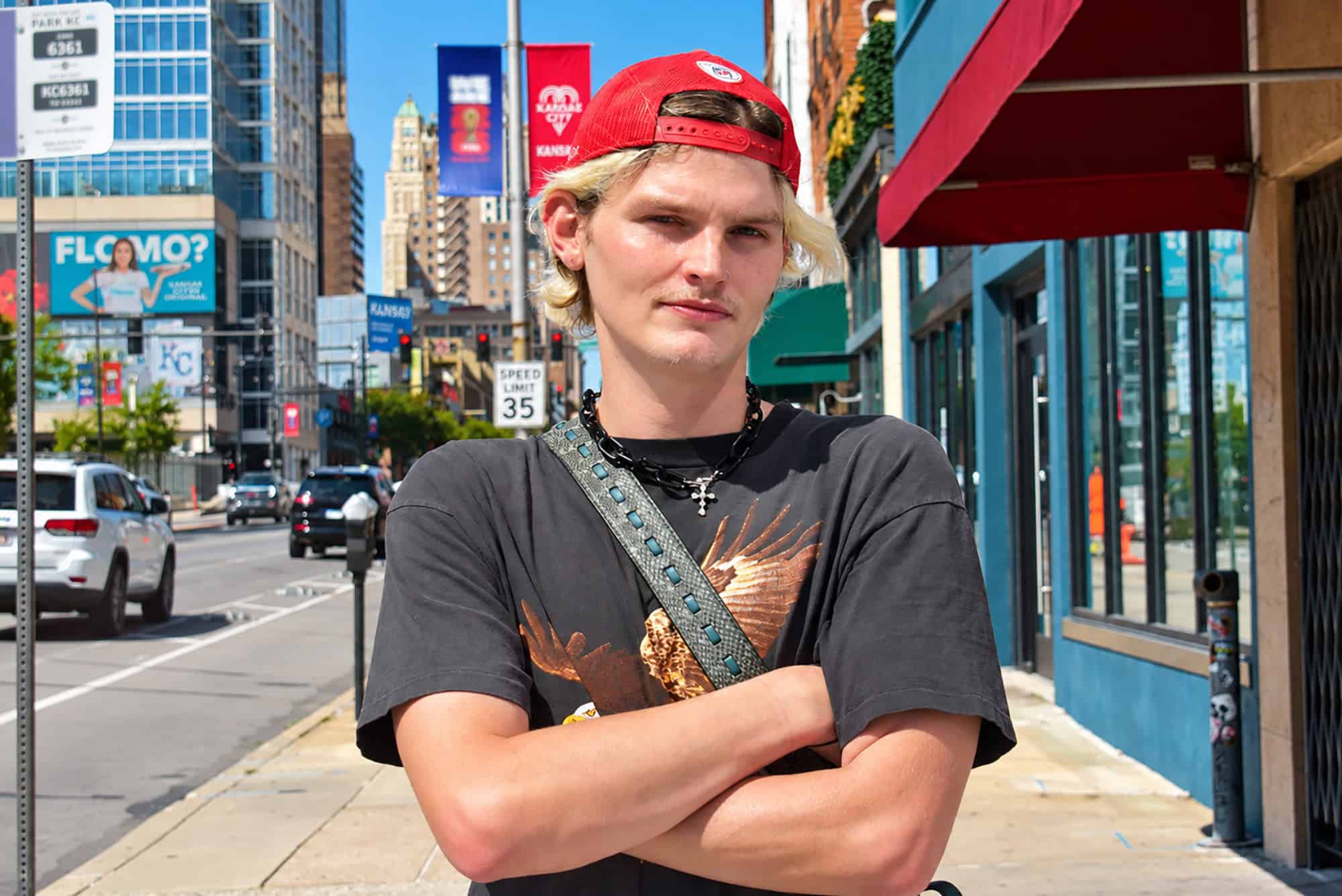
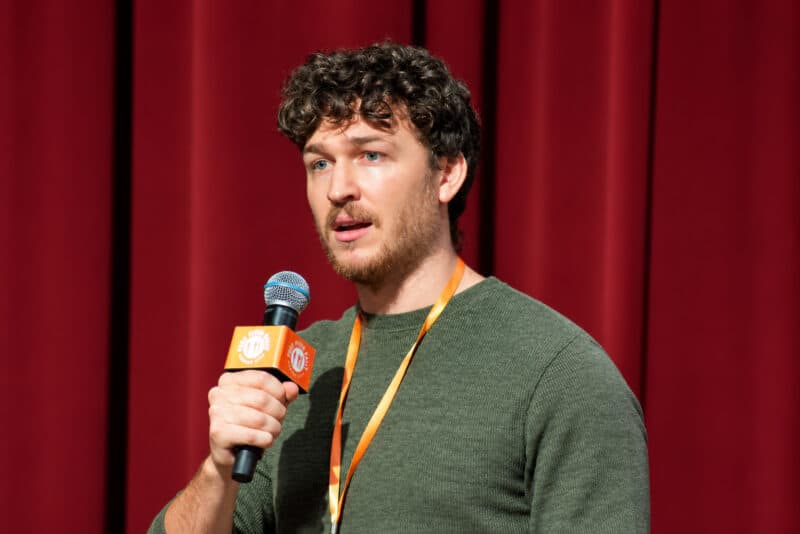
Kaleb Murray in Kansas City's Crossroads Arts District, near downtown; photo by Taylor Wilmore, Startland News
A silly TikTok about an old Craigslist car ad probably wasn’t supposed to be the thing that introduced music artist Kaleb Murray to a new audience. Then it pulled 2 million views.
Murray had tucked one of his songs into the background of the video, figuring people would react to the bizarre ad while his music quietly played underneath. As the views started piling up, he realized the experiment had worked.
That viral moment gave Murray a taste of what could happen when people actually heard his music, but the revelation also arrived at a pivotal point in his life.
The Kansas City native had already spent about a decade modeling, signing with Elite Model Management after high school and working between Kansas City, New York and Los Angeles, with appearances in Teen Vogue along the way.
Music, though, had always been Murray’s passion. The “Kans(a)s Boy” singer grew up singing in choir and had wanted to make his own music for years before finally getting serious about it.
His first release, “Runaway Heart,” arrived in March, turning a feeling of loneliness into a song and beginning a new creative chapter that he is building largely on his own.
Finding his sound
“Run(a)way Heart” started in a bedroom, with Murray weaving an otherwise inconsequential low moment into a song.
“I was sitting in my room, and I was just feeling kind of down and lonely,” he said. “So I wrote it.”
Once he began using Logic, Apple’s music-production software, Murray taught himself how to transform incomplete ideas and concepts into finished tracks. His stepdad, who studied music theory in college, helped him along the way, giving Murray some of the foundation he needed to keep experimenting.
“I wouldn’t have been able to do it without him,” said Murray.
Today, Murray describes his sound as indie pop with country and rock flair, drawing inspiration from a wide range of artists — Freddie Mercury and Michael Jackson to The Weeknd and Justin Bieber.
His process is hands-on, with Murray recording multiple vocal takes, pulling together the parts he likes and spending hours shaping the final composition.
He has at least eight unfinished songs sitting on his computer, he said, leaving plenty of room for experimentation and humor.
An forthcoming track, “Vogue,” turns Murray’s own image into the punchline, playing with the expectations that come with his modeling background rather than leaning into a polished version of it.
“The whole thing is just kind of like randomness,” said Murray. “It’s not like, ‘Look at me and look at how cool I am.’ It’s more like looking at how ridiculous my life is and how normal I am.”
View this post on Instagram
Changing the picture
His sense of humor has become part of how Murray is defining himself as an artist, particularly as he works to separate his music from a superficial identity with which people may already associate him.
After 10 years of modeling, Murray knows some people will naturally see him through that lens first.
“Everybody knows me for modeling, so I feel like sometimes they don’t take me seriously if they’ve been following me forever,” said Murray.
He doesn’t view modeling and music as competing careers, though. Instead, he considers both to be outlets for the same creative instinct — a perspective that allows Murray to combine his experiences traveling, meeting people, and discovering new spaces across the globe into source material for his songwriting.
“That’s a part of what allowed me to become so passionate about music these days,” he said. “I don’t know if I would have the stories to write about if I didn’t go through all of that.”
The distinction is important to him. Murray isn’t interested in being defined by one medium when he sees creativity everywhere.
“I wouldn’t call myself a musician,” said Murray. “I would call myself an artist if anything, because everything is art.”
View this post on Instagram
Making it in KC
Murray’s approach to music is just as DIY as his definition of it.
His recording setup is a walk-in closet, with blankets helping create a makeshift recording space. His laptop sits on a bookshelf, and the HyperX microphone he uses was purchased years ago at a pawn shop for about $40.
His first single was made with even less.
“I recorded Runaway Heart literally just like sitting at my computer desk, and I took a blanket and just put it over my head,” Murray recalled.
Since he hasn’t yet built a large network of collaborators and producers in Kansas City, Murray taught himself much of the production process, spending his spare time on his computer learning how to build songs from the ground up. He sees the local music scene as active and established, but his own path has largely been about figuring things out as he goes.
That connection to Kansas City has also found its way into the music itself.
Murray released “Kansas Boy” amid the buzz of this summer’s FIFA World Cup, hoping to tap into shared excitement across a city full of people who could relate to the song.
The flip side of his independence carries into the less glamorous part of releasing music: getting people to actually find and listen to it.
Murray isn’t particularly interested in becoming a TikTok personality, he said, but the entrepreneur component of being an artist in 2026 means understanding that social media has become part of the job if he wants to turn music into a sustainable career.
“Marketing on TikTok, it’s just a part of the game,” said Murray. “You have to do it. It’s not necessarily that I want to be like a TikToker, but what I want to do is make a living from my music, and I know that I have to use social media in order to get there.”
What comes next
The 2 million-view TikTok might have been Murray’s first big push, but he already has more music on the way.
He’s working to refine a cover of Dolly Parton’s “9 to 5,” along with original material including “Aftermath,” a country-leaning song that gives him another opportunity to stretch beyond the indie-pop sound he’s been developing.
Murray is also thinking about what it will take to eventually bring the music off his computer and onto a stage. He wants to perform at Pride events and local festivals, acknowledging that singing in front of people still comes with nerves. Murray is also teaching himself instruments like guitar and ukulele that could give him more independence as he begins thinking about live performances.
And his pace isn’t slowing, despite the learning curve.
Murray composed “Runaway Heart” in February, released it in March and has spent the months since learning what it means to write, produce, promote and perform as an independent artist.
“It’s already the end of summer,” he said. “But I’m just learning as I go, and I’m having fun doing it too.”
That sense of discovery runs through Murray’s music so far. The 2 million views might have gotten people to stop scrolling once, but for Murray, the goal is less about chasing another viral moment and more linked to building something fans will seek out.
“I would be satisfied if if one person listens to one thing and they find joy out of it, then I’m already cool,” he said.
Fund More Stories
This story was made possible by readers like you. Join them — make a one-time contribution or become a monthly member to sustain our work.