UMKC student-staff duo hopes to scale hydroponic lettuce from ‘six-by-six footprint’ to food insecurity solution
June 17, 2026 | Hunter Miesner, UMKC
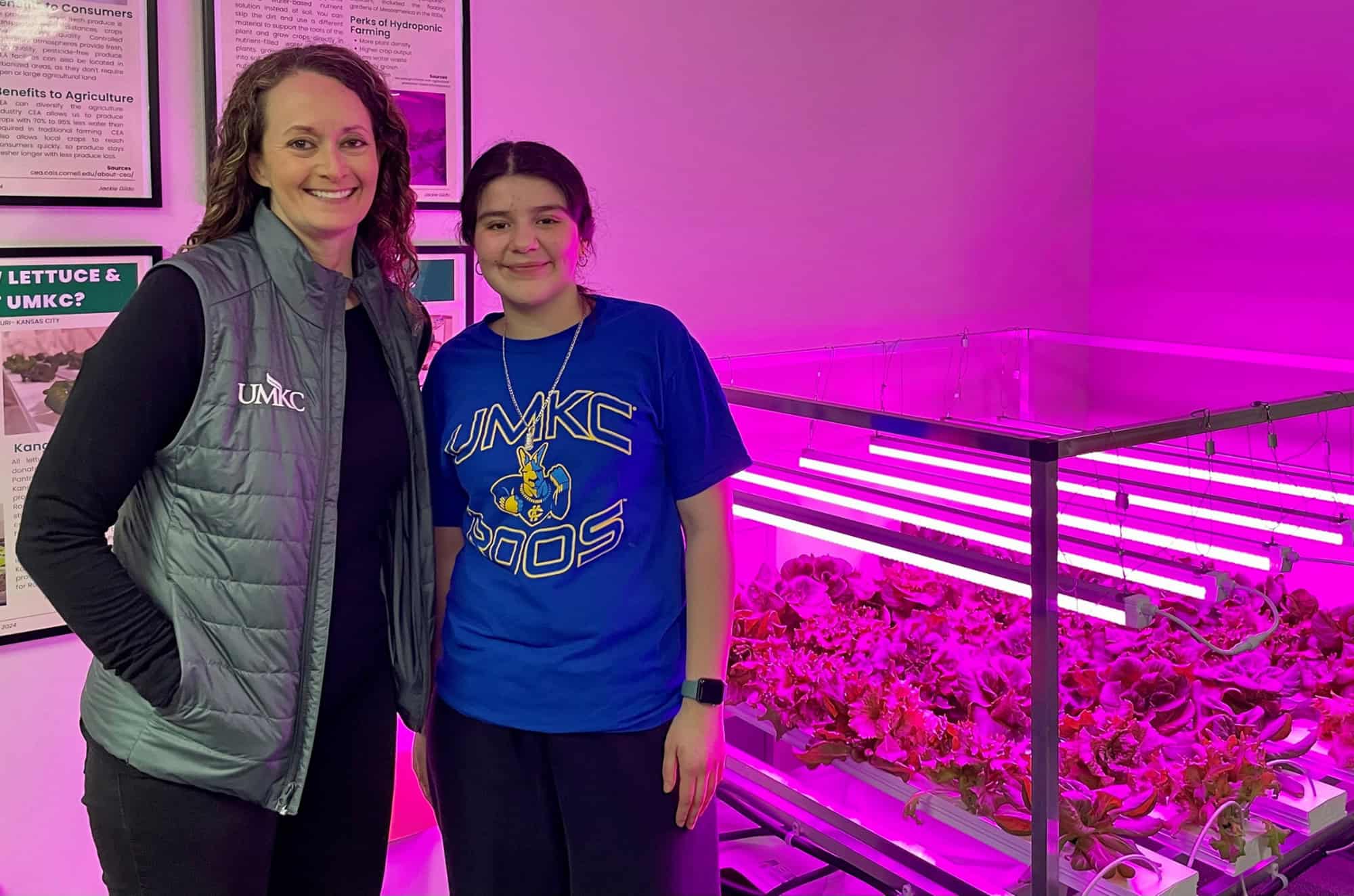
Angela Cottrell, Ed.D., director of research and institutional programs at UMKC, and Jackie Gildo, a junior at UMKC, stand near a hydroponic lettuce growing system; courtesy photo
This story was originally published by UMKC. Click here to read the original piece.
In the Midwest, fresh produce often travels more than 1,500 miles before reaching the table. At the University of Missouri-Kansas City, a student-staff duo is working to make produce more accessible through a certification program in controlled-environment agriculture.
Despite Missouri ranking third in the nation for number of farms, food insecurity remains widespread. One in six Missourians experience food insecurity, including more than 248,000 children, according to Feeding America.
A 2023 United Way of Greater Kansas City report found more than 180,000 people in the metro area face food insecurity, with the highest rates in Wyandotte, Clay and Jackson counties.
So why does high agricultural production not translate into equitable food access?
In her report presented at Undergraduate Research Day at the Capitol, Jackie Gildo, a junior studying business administration with an emphasis in nonprofit management, wrote:
“Fresh produce often travels more than 1,500 miles before reaching a Missouri dinner table. Local communities still depend on long-distance distribution systems that increase food waste, raise costs and reduce freshness by the time produce reaches communities.”
At UMKC, Gildo and her mentor are building a solution.
What started as a single hydroponic growing system on the second floor of Flarsheim Hall has transformed into a $733,000 USDA-NIFA-funded initiative to develop a controlled-environment agriculture (CEA) certification program.
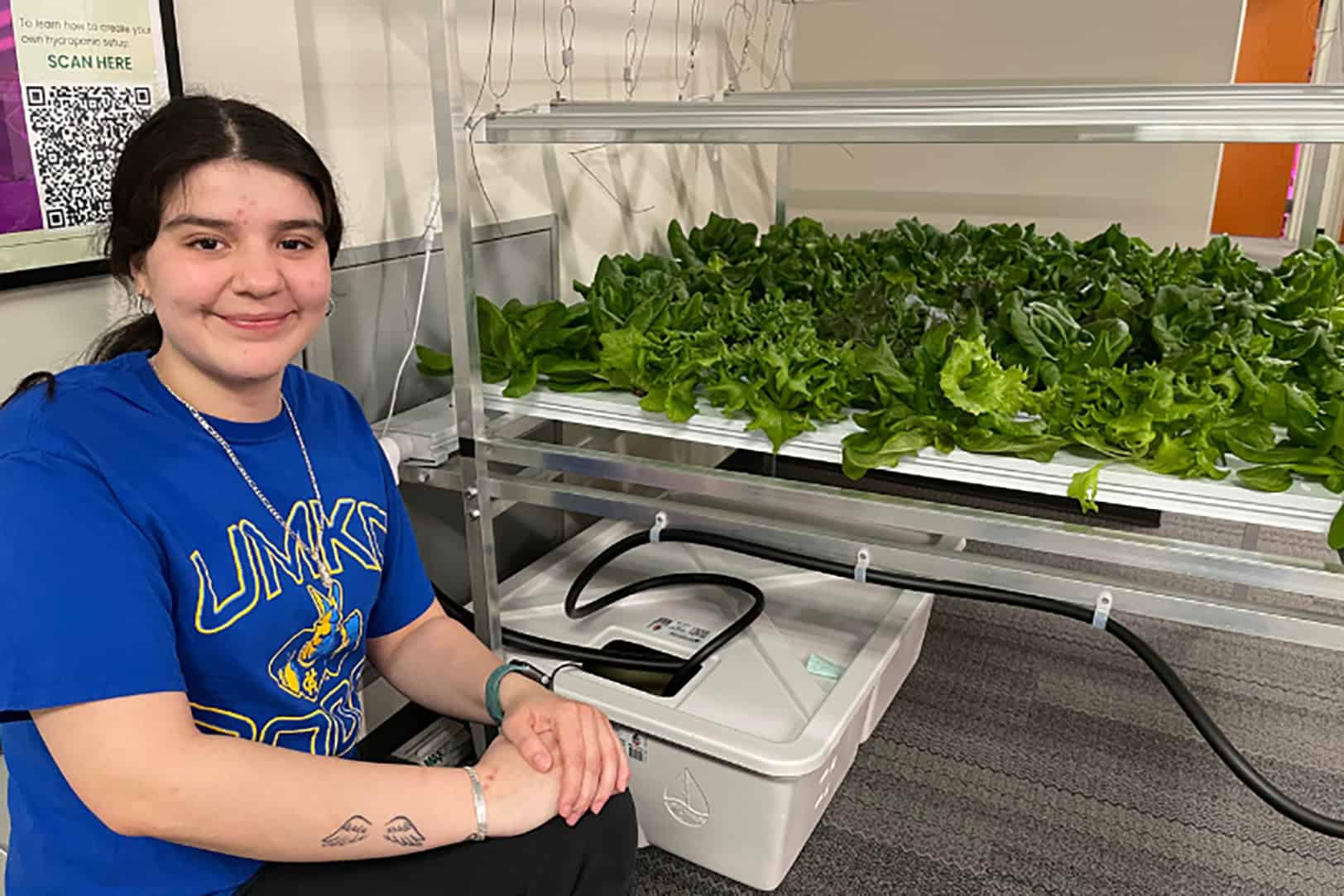
Jackie Gildo sits alongside her hydroponic lettuce growing system; courtesy photo
The program is a collaboration among UMKC, the University of Missouri, Kansas State University and Kansas State University Olathe. Students across campuses can take online coursework with in-person lab components.
At UMKC, the certification is housed in the department of Earth and Environmental Science in the School of Science and Engineering.
Leading the effort is Angela Cottrell, Ed.D., director of research and institutional programs at UMKC.
Cottrell’s path to CEA began with her work in grant writing. That role introduced her to workforce and food systems research.
“It’s personally important for me to understand where my food comes from,” Cottrell said. “My entire family are type 2 diabetics. The pandemic really hit home the realities of food supply chain gaps.”
Gildo discovered undergraduate research during UMKC Welcome Week and applied to work with Cottrell. She began by helping build the hydroponic lettuce growing system.
“Hydroponic growing systems allow crops to be produced in compact indoor spaces, making year-round production possible even in urban areas,” Gildo said. “We are pioneering this framework to show there is a viable, feasible solution for our community’s food needs.”
Since its first harvest in April 2024, the system has produced 183.75 pounds of lettuce, all donated to the Kangaroo Pantry at the Dr. Raj Bala Agrawal CARE Center.
The produce goes from harvest to pantry in about two hours, significantly reducing spoilage and preserving freshness.
Cottrell described it as some of the freshest lettuce available.
Gildo also surveyed Kangaroo Pantry users to understand campus food needs. Fresh fruits and vegetables were the top request with 31% of students selecting them.
Now, Gildo and Cottrell are helping expand the CEA certification program, aiming to enroll at least 20 students from each participating university this fall.
Cottrell said student interest was strong: 89% of UMKC students expressed interest in a lab or greenhouse where they can participate in growing crops, and 53% said they would participate in a CEA program.
Gildo is also contributing through marketing and outreach efforts tied to her business education at the Henry W. Bloch School of Management.
“As a business student, being able to take a slice of her work and build on it feels empowering,” Gildo said. “Angie is really the reason why I keep coming back. She lets me be creative, explore my own ideas and connects me to opportunities I wouldn’t have found on my own. She’s always thinking about ways to set me up for success. She’s a great mentor who believes in my potential, and having someone believe in you really changes the way you go about your future; it helps me stay engaged in my studies.”
Gildo describes the project as both hands-on and scalable.
“This is just a six-by-six footprint,” she said. “But nearly 200 pounds of lettuce from something this small shows how it can scale into something much bigger.”
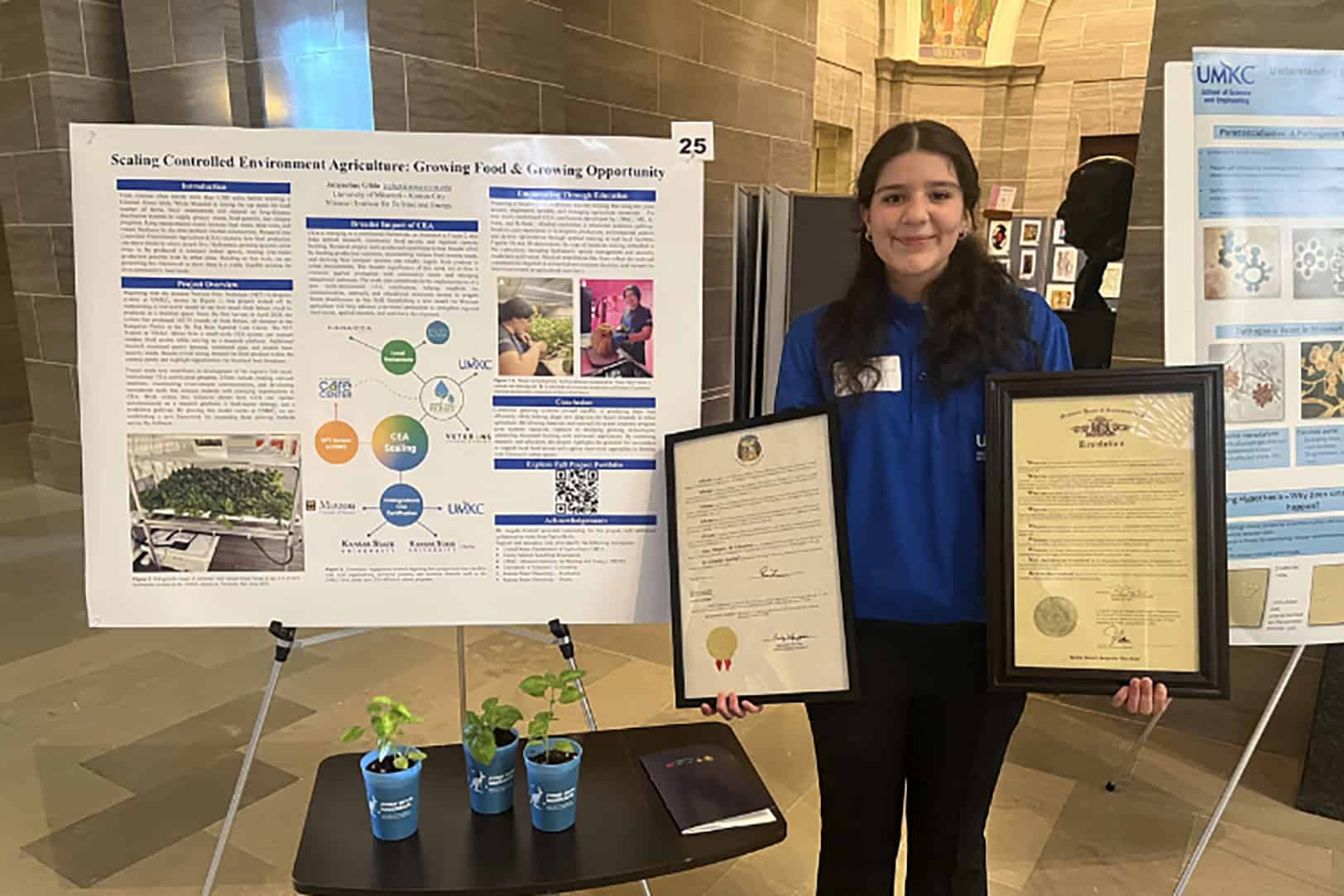
Jackie Gildo, a junior at UMKC studying business administration with an emphasis in nonprofit management, stands with an award-winning display during Undergraduate Research Day at the Missouri State Capitol, which earned her recognitions from two Missouri lawmakers; courtesy photo
“I got two official resolutions, one from Sen. Patty Lewis and one from Rep. Melissa Douglas,” Gildo said. “It was very gratifying to see my research officially recognized at a state level. I don’t think anything will ever beat that.”
For Gildo and Cottrell, the goal is not just producing lettuce but building a new model for Missouri agriculture that connects food production, education and access.
As Gildo wrote in her research, “Establishing a new model for Missouri agriculture will help advance year-round production to strengthen regional food access, applied research and workforce development.”
The undergraduate certificate in Controlled Environement Agriculture may only be awarded in conjunction with a UMKC undergraduate degree. Students interested in enrolling should contact Angela Cottrell, the IDEA Coordinator, prior to enrollment.